
THE MŌTUS BLOG
June 29, 2026
Why See a Chiropractor for Movement Restoration
You notice it when your body stops cooperating with the life you want to live. Squats feel uneven. Your neck won’t rotate cleanly when you back out of the driveway. Your low back tightens after a flight, a workout, or a day at the desk. If you’re searching for a chiropractor for movement restoration, you’re probably not looking for another temporary fix. You want your body to work again - with more range, less resistance, and fewer setbacks.
That distinction matters. A lot of people wait until movement loss becomes pain, and by then the problem has usually been building for months or years. Stiff joints, poor posture, muscle compensation, and spinal dysfunction rarely show up all at once. They accumulate quietly, then start stealing performance, energy, and confidence. You do not need to settle for that decline just because it is common.
How do Chiropractors actually restore movement?
Movement restoration is not the same thing as chasing symptoms. Pain might be the reason you book the appointment, but limited movement is often the bigger story. When the spine loses proper alignment and motion, the body adapts. One area becomes restricted, another works harder to compensate, and patterns of tension begin to spread.
A chiropractor focused on movement restoration looks beyond where it hurts. The goal is to identify what is blocking normal function in the first place. That may include spinal misalignment, joint fixation, postural collapse, reduced segmental motion, muscle guarding, or nervous system irritation that changes how your body coordinates movement.
This is where quality matters. Not every chiropractic office is built for corrective care. Some deliver quick adjustments aimed at short-term relief. That can feel good for a day or two, but if the underlying mechanics stay the same, your body goes right back to the pattern that created the problem. Real restoration requires a more exact approach.
Why movement loss happens in the first place
Most active adults assume movement problems come from one obvious cause - a hard workout, an old injury, bad sleep, too much sitting. Sometimes that is true, but more often it is a stack of stressors.
Long hours at a laptop can shift posture forward and reduce spinal extension. Repetitive training can load the same movement pattern until mobility disappears elsewhere. Old car accidents, sports injuries, and even small falls can leave behind compensation patterns that never fully resolve. Add stress, poor recovery, and daily habits that keep reinforcing asymmetry, and suddenly your body is surviving instead of moving well.
Pain does not always show up where the dysfunction started. Headaches can trace back to restricted neck mechanics. Shoulder irritation may have more to do with thoracic stiffness and posture than the shoulder itself. Hip tightness can be influenced by what the lumbar spine and pelvis are doing. This is why symptom-only treatment misses so much.
The difference between relief care and corrective care
If you have tried traditional approaches and keep ending up in the same place, you are not imagining the pattern. Many people cycle through rest, medication, massage, stretching, and occasional adjustments without ever getting a clear answer for why their movement keeps breaking down.
Relief care has a place. When pain is intense, reducing symptoms matters. But if the plan stops there, you are left managing the consequences instead of correcting the source. Corrective care asks harder questions. What is not moving that should be moving? What has shifted out of alignment? Where is your body compensating? What objective changes can be measured over time?
That is the standard ambitious patients should expect. Not guesswork. Not generic treatment. Not a provider who rushes you through the same routine given to everyone else.
What to expect from a thorough movement restoration process
A serious chiropractor for movement restoration should start with data, not assumptions. That means a detailed conversation about your symptoms, training, work demands, injury history, and goals. It also means evaluating posture, joint motion, movement quality, and spinal function with enough depth to see what the body is actually doing.
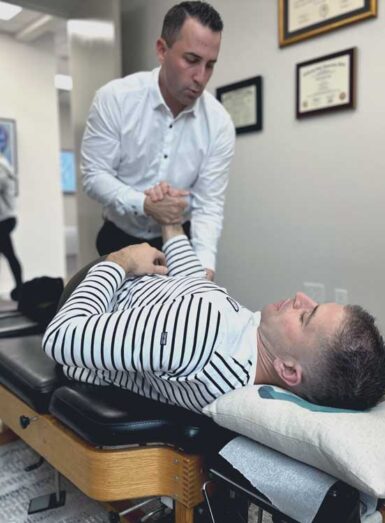
In a more advanced corrective setting, that process may include range-of-motion testing and pre- and post-motion X-ray studies. Those tools help show whether the spine is moving properly, where restriction exists, and how structural changes relate to the symptoms and limitations you feel day to day. For the right patient, this kind of testing changes the entire experience because progress is no longer based on vague impressions alone.
From there, care should be individualized. Some people need a stronger focus on cervical correction because headaches, forward head posture, and neck restriction are driving everything else. Others need pelvic and lumbar correction to improve gait, hip function, and low back stability. Some need a broader full-spine approach because the dysfunction is layered.
This is also where honesty matters. Movement restoration is not usually instant. If your spine and posture have been adapting for years, meaningful correction takes time and consistency. The upside is that when care is specific and measurable, you are no longer chasing random relief. You are building better mechanics.
Signs you may need movement restoration, not just pain relief
Some people know they need help because the pain is obvious. Others are still functioning, but they know their body is underperforming. That second group often waits too long.
If you feel stiff when you should feel capable, pay attention. If one side of your body always feels tighter, if your posture keeps collapsing, if workouts aggravate the same area, if travel wrecks your back, or if you keep stretching without lasting improvement, your body is telling you something. Reduced mobility, recurring tension, poor recovery, headaches, balance changes, and visible postural shifts can all point to a deeper movement problem.
The real cost is not just discomfort. It is what dysfunction takes away from your life. It can limit training, concentration, sleep, confidence, and the ability to stay fully engaged at work or with your family. Stop normalizing that trade-off.
Why diagnostics matter if you want real change
Wellness language is widely accepted and understood. Measurable progress is harder, and far more valuable.
If your goal is true movement restoration, objective testing matters because it gives you a baseline and a way to track whether care is actually changing function. Without that, a lot of treatment becomes subjective. You might feel a little better for a few days, but are you gaining range? Is posture improving? Is spinal motion becoming more normal? Is the correction holding longer between visits?
At Mōtus Chiropractic, this commitment to objective analysis is a major part of what separates corrective care from mainstream symptom management. The point is not to overcomplicate your healing. The point is to stop wasting time on care that sounds promising but never proves anything.
Who benefits most from this kind of chiropractic care
Movement restoration is especially valuable for people who ask a lot from their bodies. That includes athletes, lifters, runners, desk-bound professionals, parents carrying kids all day, and high performers who need physical energy to match mental output.
It also fits people who are done with passive healthcare. If you want someone to hand you pain pills and send you home, this approach will probably feel too involved. But if you want to understand what is happening in your body, correct it at the source, and participate in your own recovery, this is the right lane.
That said, there are trade-offs. Corrective care asks for commitment. It may involve a structured care plan instead of a couple casual visits. It may require changes to posture habits, workstation setup, recovery routines, or movement patterns outside the office. For serious adults who want lasting results, that is not a burden. It is the price of real change.
Choosing the right chiropractor for movement restoration
Do not choose based on convenience alone. Choose based on whether the doctor is equipped to assess and correct the deeper issue.
Look for a provider who explains findings clearly, uses meaningful diagnostics, builds customized plans, and talks about long-term function instead of endless symptom chasing. You should feel challenged, educated, and confident that there is a strategy behind the care. If every patient gets the same quick adjustment, keep looking.
The right chiropractor will not just ask where it hurts. They will ask how you want to live, train, work, and move - then build a plan that supports that outcome. That is a very different standard of care, and it is exactly what high-performing adults should demand.
Your body was built for more than maintenance-level survival. It was built to adapt, perform, and move with freedom. When movement starts disappearing, do not wait for the problem to become your new normal. Get specific, get measured, and give your body a real chance to heal the way it was designed to.
Mōtus Chiropractic is a top-rated chiropractor located in Austin, TX. Dr. Mike Isseks offers more than 15 years experience helping his patients alleviate pain and Move Consciously. To schedule a visit, click here.
RECLAIM YOUR LIFE
Rebuild your body and reduce your pain with our progressive technology, proven alternative methods of care, and integrative chiropractic experience.
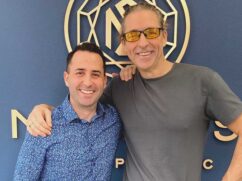
“Dr. Mike improved the mobility of my spine measurably. The whole team is incredibly flexible and helpful to work with. Everything is fast and easy.”

Author, biohacker, and founder of Bulletproof Nutrition

“Dr. Mike and the team at Mōtus are top notch. The adjustments are specific and the analysis is beyond thorough. If you’re in Austin, this is the spot for high-level Chiropractic care.”
– Adrian Grenier
Actor and Film Producer

ABOUT DR. MIKE ISSEKS
Dr. Mike has been a practicing chiropractor for more than 15 years. He is a graduate of California State University at Chico and received his Doctor of Chiropractic degree from Life Chiropractic College West. He specializes in corrective care chiropractic, improving posture, as well as optimizing spinal motion to help uncover the best version of those he serves.
STAY IN THE KNOW
Get cutting-edge health tips, updates, and event notifications...
By entering your email above and clicking “Sign-Up,” you agree to receive occasional emails from Mōtus Chiropractic.
VISIT US
Trio at Menchaca Business Park
Ample free parking in the front lot
HOURS
Monday, Tuesday, Thursday
8:30 am – 12 pm
2:30 pm – 6 pm
Wednesday
12 pm – 5 pm
REACH US
(512) 777-2680
hello@motusatx.com
STAY IN THE KNOW
Get cutting-edge health tips, updates, and event notifications...
By entering your email above and clicking “Sign-Up,” you agree to receive occasional emails from Mōtus Chiropractic.
Copyright 2022, Mōtus Chiropractic. All rights reserved.