
THE MŌTUS BLOG
June 10, 2026
Best Corrective Approach for Tech Neck
You can stretch your neck between meetings, switch to a standing desk, and book the occasional massage - and still feel that same dull pull at the base of your skull by Thursday. That is why people start searching for the best solution for tech neck. They are not looking for another temporary fix. They want to know why their neck keeps tightening, why headaches keep returning, and what actually changes the pattern for good.
Tech neck is not just a modern annoyance. It is a structural stress pattern. Hours of looking down at a laptop or phone push the head forward, round the shoulders, and load the cervical spine far beyond what it was designed to handle. Over time, that strain can spill into headaches, shoulder tension, reduced mobility, numbness, upper back pain, and even fatigue. If you are active, ambitious, and used to performing at a high level, it can quietly chip away at everything from focus to training capacity.
What actually works for tech neck
The best treatments for tech neck are the ones that match the cause of the problem. If your issue is mild muscle tension from a short-term posture slump, simple mobility work and workstation changes may help. But if your posture has been collapsing for months or years, and your spine has adapted to that pattern, symptom relief alone is not enough.
That is the part conventional care often misses. Pain is the alarm, not the full diagnosis. You can numb the discomfort, loosen the muscles, or get a quick adjustment, but if the underlying mechanics stay the same, your body will keep recreating the tension.
Real treatment usually requires a layered approach - one that reduces irritation, improves alignment, restores movement, and retrains your posture so your spine is no longer fighting gravity all day.
Corrective chiropractic care
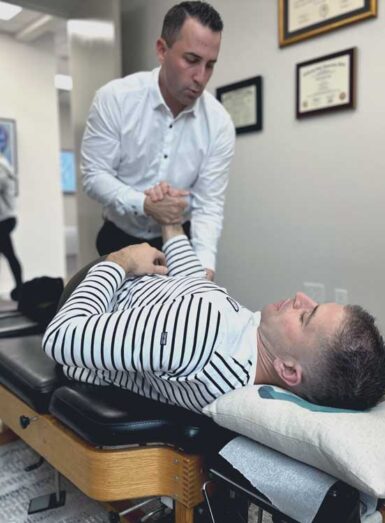
When tech neck has progressed beyond occasional stiffness, corrective chiropractic care can be one of the most effective options. Not generic, high-volume adjustments. Corrective care.
That distinction matters. A corrective approach looks at how the cervical spine is moving, where alignment has been lost, and how those changes affect the nervous system, surrounding muscles, and overall posture. The goal is not to chase symptoms. It is to restore function.
For many patients, this is where progress finally starts to feel real. Instead of getting temporary relief for a day or two, they begin seeing measurable improvement in range of motion, posture, tension patterns, and headache frequency. Objective testing and imaging can be especially valuable here because they show whether the spine is actually changing or whether treatment is simply making the pain easier to tolerate.
Posture retraining
You cannot out-adjust ten hours a day of poor ergonomics and forward head posture. If your body spends most of the day reinforcing the same collapsed position, treatment has to include active retraining.
Posture correction is not about forcing yourself to sit ramrod straight. That usually fails because it relies on tension, not support. Effective posture retraining focuses on rebuilding the muscular and structural capacity to hold a healthier position naturally. That may involve strengthening the deep neck flexors, opening the chest, improving thoracic extension, and teaching the shoulders and rib cage to stack better over the pelvis.
This is one of the most overlooked treatments because it is less glamorous than a quick intervention. It also happens to be one of the most important. If you want lasting change, your body needs a new default pattern.
Targeted mobility and rehab exercises
The right exercises can help significantly. The wrong ones can waste time or aggravate the issue.
A lot of people with tech neck jump straight into random stretches they found online. Sometimes those give short-lived relief. Sometimes they reinforce instability by pulling on already irritated tissue without addressing why that tissue is overloaded in the first place.
A better strategy is targeted rehab. That often includes chin tuck variations, thoracic mobility work, scapular stabilization, and controlled strengthening for the upper back and postural chain. The purpose is not just to make your neck feel looser. It is to improve how the whole system functions.
If your neck pain is paired with pinching, radiating symptoms, dizziness, or recurring headaches, exercise should not be guesswork. It should be prescribed based on what your spine and movement patterns are actually doing.
The treatments that help, but do not go far enough alone
Some treatments deserve a place in the conversation because they can provide relief. They just should not be mistaken for complete solutions.
Massage therapy
Massage can reduce muscle guarding, improve circulation, and help you feel better fast. For many people with tech neck, tight traps, suboccipitals, and upper back muscles respond well to soft tissue work.
But massage mostly addresses the output of the problem, not the source. If your head is still living inches in front of where it should be, those muscles will tighten again because they are still doing compensation work. Massage is useful support care. By itself, it rarely creates lasting structural change.
Anti-inflammatory medication
Medication may reduce pain enough to get through a workday or a rough flare-up. There is a time and place for symptom management. But if that is the entire plan, you are not treating tech neck. You are muting the signal.
That trade-off matters. Pain relief can create the illusion of progress while the underlying stress pattern continues. For someone committed to long-term health, that is a dangerous bargain.
Ergonomic upgrades
A better chair, monitor height adjustment, laptop stand, or external keyboard can make a meaningful difference. If your setup is forcing your spine into a compromised position all day, changing the environment is smart.
Still, ergonomics are not magic. They reduce strain, but they do not reverse structural adaptations that have already taken hold. Think of them as support for recovery, not the recovery itself.
When tech neck feels like more
Not every case is simple postural tension. Sometimes the neck pain is tied to deeper spinal dysfunction, loss of cervical curve, restricted joint motion, disc irritation, or nerve involvement. In those situations, the best treatments for tech neck need to be more precise and more personalized.
That is why a real evaluation matters. If you have recurring headaches, numbness into the arm, sharp pain with rotation, chronic shoulder blade tension, or symptoms that keep returning no matter what you try, stop settling for trial and error. You need to know what is happening mechanically.
A high-level assessment may include spinal motion analysis, posture evaluation, orthopedic testing, and imaging when appropriate. Done well, that process gives you something most people never get in healthcare - clarity. Not a vague label. Not another generic recommendation. A clear map of what is wrong, what can improve, and what it will take to change it.
For active adults in Austin who care about performance and longevity, that level of specificity is not excessive. It is responsible.
How to choose the best treatment plan for tech neck
The right plan depends on severity, duration, and what your body has adapted to. If your symptoms started recently and mainly show up after long screen sessions, a combination of ergonomic correction, mobility work, and posture awareness may be enough to reverse the trend.
If the issue has become chronic, or if you are dealing with repeated flare-ups, headaches, reduced mobility, or nerve symptoms, your treatment needs to go deeper. That usually means combining corrective chiropractic care with targeted rehab and measurable posture restoration.
The key question is simple: are you trying to feel better this week, or are you trying to fix what keeps making you hurt? Both matter, but they are not the same goal.
At practices like Mōtus Chiropractic, the emphasis is on root-cause care because high performers do not need another bandage. They need a plan that respects how the body actually heals - through alignment, motion, adaptation, and consistency.
What lasting progress usually looks like
Healing from tech neck is rarely one dramatic moment. It is a sequence. Pain starts easing. Range of motion improves. Headaches become less frequent. Posture feels less forced. Workouts feel cleaner. Energy improves because your body is no longer spending all day fighting compensations.
Then something bigger happens. You stop thinking about your neck all the time.
That is the real standard. Not temporary relief. Not surviving the workweek. A body that moves the way it was designed to move, without constant tension stealing your attention.
If you are serious about finding the best treatments for tech neck, choose care that goes beyond symptom control. Get specific. Get measured. Rebuild the structure, not just the comfort. Your spine has been adapting to your habits for years. With the right plan, it can adapt in a better direction too.
Mōtus Chiropractic is a top-rated chiropractor located in Austin, TX. Dr. Mike Isseks offers more than 15 years experience helping his patients alleviate pain and Move Consciously. To schedule a visit, click here.
RECLAIM YOUR LIFE
Rebuild your body and reduce your pain with our progressive technology, proven alternative methods of care, and integrative chiropractic experience.

“Dr. Mike improved the mobility of my spine measurably. The whole team is incredibly flexible and helpful to work with. Everything is fast and easy.”

Author, biohacker, and founder of Bulletproof Nutrition

“Dr. Mike and the team at Mōtus are top notch. The adjustments are specific and the analysis is beyond thorough. If you’re in Austin, this is the spot for high-level Chiropractic care.”
– Adrian Grenier
Actor and Film Producer

ABOUT DR. MIKE ISSEKS
Dr. Mike has been a practicing chiropractor for more than 15 years. He is a graduate of California State University at Chico and received his Doctor of Chiropractic degree from Life Chiropractic College West. He specializes in corrective care chiropractic, improving posture, as well as optimizing spinal motion to help uncover the best version of those he serves.
STAY IN THE KNOW
Get cutting-edge health tips, updates, and event notifications...
By entering your email above and clicking “Sign-Up,” you agree to receive occasional emails from Mōtus Chiropractic.

VISIT US
Trio at Menchaca Business Park
Ample free parking in the front lot
HOURS
Monday, Tuesday, Thursday
8:30 am – 12 pm
2:30 pm – 6 pm
Wednesday
12 pm – 5 pm
REACH US
(512) 777-2680
hello@motusatx.com
STAY IN THE KNOW
Get cutting-edge health tips, updates, and event notifications...
By entering your email above and clicking “Sign-Up,” you agree to receive occasional emails from Mōtus Chiropractic.
Copyright 2022, Mōtus Chiropractic. All rights reserved.