
THE MŌTUS BLOG
October 5, 2026
Chiropractic for Desk Workers Who Want More
Your workday may end at 5, but the position you held for eight hours can follow you into your workout, your sleep, and your weekend. Chiropractic for desk workers is not about chasing the tight spot between your shoulders after another video-call marathon. It is about identifying the movement and alignment patterns that keep creating that tension in the first place.
A standing desk, an expensive ergonomic chair, and a few shoulder rolls are not a complete strategy. They can help, but they cannot automatically restore motion your spine has gradually lost or undo the habit of living with your head forward, ribs collapsed, and hips locked in place. If you expect a lot from your body outside the office, stop accepting less from it at your desk.
Desk Work Creates a Pattern, Not Just a Sore Back
Sitting is not inherently harmful. Your body is built to sit, just as it is built to squat, walk, rotate, and rest. The problem is sustained, repetitive positioning without enough variation or recovery. When the same posture becomes your default for hours every day, your body adapts to it.
The head often drifts forward toward the screen. The upper back rounds. The shoulders rotate inward. Hip flexors remain shortened while the glutes contribute less. Over time, the neck, thoracic spine, low back, and pelvis may stop moving as freely as they should. The discomfort is real, but pain is often only the message, not the full problem.
That is why a quick massage, pain reliever, or generic adjustment can feel good without changing much long term. Relief matters, but relief alone is not the finish line. For high-performing professionals, founders, creatives, and active adults, the better question is: What is my body compensating for, and can that pattern be measured and improved?
How Chiropractic for Desk Workers Should Work
Effective care starts with more than asking where it hurts. A thorough chiropractic evaluation considers posture, spinal alignment, range of motion, movement quality, daily demands, health history, and the goals that matter to you. Someone training for a half marathon needs a different plan than someone whose priority is getting through a workday without headaches and exhaustion.
At Mōtus Chiropractic, corrective care is built around objective findings rather than assumptions. That may include detailed posture analysis, advanced range-of-motion testing, and, when clinically appropriate, pre- and post-motion X-ray studies. These tools help reveal restrictions, asymmetries, and structural dysfunction that may not be obvious from symptoms alone.
The goal is better function, not endless appointments
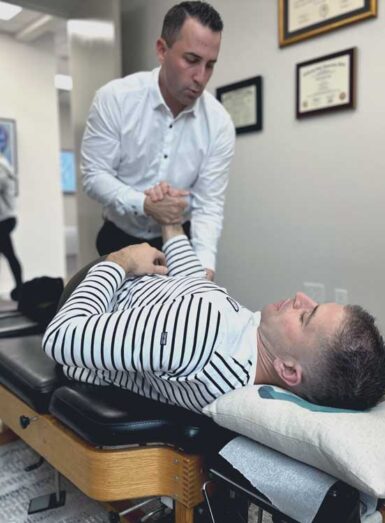
A personalized corrective plan may include chiropractic adjustments intended to improve joint motion, targeted mobility work, posture retraining, and practical changes to how you work and recover. The exact approach depends on your exam findings, your condition, and how your body responds over time.
This is not a promise that every desk-related ache has one cause or that chiropractic is the right answer for every person. Some symptoms require collaboration with a physician, physical therapist, specialist, or other provider. But when restricted spinal motion, postural strain, and movement compensation are part of the picture, a precise chiropractic plan can be a meaningful piece of a long-term solution.
The standard should be progress you can feel and, when possible, measure: easier rotation when backing out of a parking spot, fewer tension headaches, more comfortable training, improved posture endurance, or less stiffness when you stand after a meeting. Care should evolve as your function improves. You are not there to be managed indefinitely. You are there to restore capacity.
Why One Adjustment Is Rarely the Whole Answer
A single adjustment may provide welcome relief. There is nothing wrong with that. But if your spine returns to the same restricted positions for 40 or 50 hours each week, the old pattern has a powerful advantage.
Corrective care asks more of both patient and provider. The provider needs to assess carefully, explain what is happening, and create a plan with clear clinical reasoning. The patient needs to participate. That may mean practicing specific movements, changing screen height, taking short movement breaks, strengthening neglected ranges, and following through when symptoms have already improved.
This is where personal responsibility becomes empowering rather than burdensome. You do not need perfection. You need a strategy that makes your environment support the body you want to have. A plan that only works on vacation is not a plan.
Build a Desk Setup That Stops Working Against You
Ergonomics will not replace care for a meaningful mobility restriction, but it can stop feeding the problem. Set your primary monitor at roughly eye level so you are not repeatedly dropping your chin. Keep the keyboard and mouse close enough that your shoulders can stay relaxed instead of reaching forward all day.
Support your feet on the floor or a stable footrest, and avoid treating the chair as a place to collapse into. If you use a laptop, a separate keyboard and mouse can make a substantial difference. The issue is not finding one perfect posture and holding it rigidly. The best posture is the next posture, provided you change positions frequently and with intention.
A standing desk can be useful if it helps you alternate, not if it simply turns eight hours of sitting into eight hours of standing with your weight dumped into one hip. Shift, walk, sit, stand, and move through comfortable ranges. Your workstation should make variation easier.
Use movement breaks with a purpose
You do not need a 30-minute mobility class between emails. Two minutes of purposeful movement every 30 to 60 minutes can interrupt the buildup of stiffness. Walk to refill your water, look away from the screen, gently rotate your upper back, or perform a few controlled hip movements.
If a movement causes sharp pain, numbness, worsening symptoms, or dizziness, do not force your way through it. Get evaluated. The goal is to teach your body that it has options, not to turn a break into another performance test.
The Desk May Be Exposing a Bigger Issue
Desk work gets blamed for plenty, but it may also expose limitations built elsewhere. An old sports injury, a previous car accident, poor sleep, heavy training volume, stress, or years of uneven movement can all influence how your body handles a seated workday. The person with the same desk setup as you may feel fine because their mobility, strength, recovery, and history are different.
That is why one-size-fits-all advice falls short. Generic stretches can be useful, yet they are not a diagnosis. If your neck pain returns every afternoon, your headaches are becoming more frequent, your low back catches when you stand, or you have lost confidence in training, the pattern deserves a closer look.
Seek prompt medical evaluation for symptoms such as new weakness, significant numbness, loss of coordination, severe unrelenting pain, changes in bowel or bladder control, fever, or symptoms after substantial trauma. These are not problems to self-treat at a standing desk.
Reclaim More Than a Pain-Free Workday
Your body should support the work you care about, not make you negotiate with it by midafternoon. The objective is not merely to survive your inbox with less tension. It is to leave the office with enough movement, energy, and confidence to train, play with your kids, explore Austin, and show up fully for the life you are building.
If your desk has become the place where headaches, stiffness, and poor posture quietly accumulate, do not settle for another temporary workaround. Get clear on what your spine is doing, commit to the work that changes the pattern, and give your body a standard higher than getting through the day.
Mōtus Chiropractic is a top-rated chiropractor located in Austin, TX. Dr. Mike Isseks offers more than 15 years experience helping his patients alleviate pain and Move Consciously. To schedule a visit, click here.
RECLAIM YOUR LIFE
Rebuild your body and reduce your pain with our progressive technology, proven alternative methods of care, and integrative chiropractic experience.

“Dr. Mike improved the mobility of my spine measurably. The whole team is incredibly flexible and helpful to work with. Everything is fast and easy.”

Author, biohacker, and founder of Bulletproof Nutrition

“Dr. Mike and the team at Mōtus are top notch. The adjustments are specific and the analysis is beyond thorough. If you’re in Austin, this is the spot for high-level Chiropractic care.”
– Adrian Grenier
Actor and Film Producer

ABOUT DR. MIKE ISSEKS
Dr. Mike has been a practicing chiropractor for more than 15 years. He is a graduate of California State University at Chico and received his Doctor of Chiropractic degree from Life Chiropractic College West. He specializes in corrective care chiropractic, improving posture, as well as optimizing spinal motion to help uncover the best version of those he serves.
STAY IN THE KNOW
Get cutting-edge health tips, updates, and event notifications...
By entering your email above and clicking “Sign-Up,” you agree to receive occasional emails from Mōtus Chiropractic.
VISIT US
Trio at Menchaca Business Park
Ample free parking in the front lot
HOURS
Monday, Tuesday, Thursday
8:30 am – 12 pm
2:30 pm – 6 pm
Wednesday
12 pm – 5 pm
REACH US
(512) 777-2680
hello@motusatx.com
STAY IN THE KNOW
Get cutting-edge health tips, updates, and event notifications...
By entering your email above and clicking “Sign-Up,” you agree to receive occasional emails from Mōtus Chiropractic.
Copyright 2022, Mōtus Chiropractic. All rights reserved.