
THE MŌTUS BLOG
August 4, 2026
Adult Postural Assessment Austin for Better Movement
Your body is always communicating. The question is whether anyone is listening closely enough to understand the message. An adult postural assessment Austin residents can trust is not a quick glance at uneven shoulders or a generic reminder to sit up straight. It is an objective look at how your spine moves, where your body compensates, and why pain, stiffness, fatigue, or reduced performance may keep returning.
For ambitious adults, posture is not a cosmetic concern. It is a performance variable. It can affect how you train, recover, breathe, work at a desk, drive across town, and show up for the people who count on you. Stop settling for temporary relief when your body may be asking for a deeper answer.
What an Adult Posture Assessment in Austin Should Measure
A meaningful posture assessment goes beyond standing in front of a mirror. Visual posture matters, but it is only one part of the picture. A body can look relatively balanced while still carrying significant restrictions in spinal motion, muscle tension, or joint mechanics.
A comprehensive assessment should examine your standing alignment, spinal curves, shoulder and pelvic position, gait, range of motion, and movement patterns. It should also connect those findings to your symptoms, goals, training history, work demands, and past injuries. The goal is not to label every asymmetry as a problem. Human bodies are not perfectly symmetrical. The goal is to identify patterns that may be limiting function or forcing your body to compensate.
At Mōtus Chiropractic, that process can include advanced range-of-motion diagnostics and pre- and post-motion X-ray studies when clinically appropriate. These tools help reveal how vertebrae move under motion, not simply how they appear in a single static image. That distinction matters when someone has recurring headaches, persistent neck tension, low back pain, reduced rotation, or a sense that their body never fully resets after activity.
Posture Is a Result, Not a Character Flaw
You have probably heard that poor posture comes from slouching, weak core muscles, or spending too much time on your phone. Those factors can contribute, but they are rarely the whole story. Posture is often the result of the nervous system adapting to stress, injury, repetitive positions, restricted joints, breathing habits, and the demands of daily life.
A forward head position, for example, may be connected to limited upper-back mobility, old whiplash, jaw tension, shoulder restrictions, or hours spent looking down at a laptop. An uneven pelvis may reflect a movement strategy developed after an ankle injury, hip pain, or years of favoring one side. Stretching the tight area may feel good, but it may not change the reason that area keeps tightening.
This is where mainstream, symptom-only care often falls short. A massage, pain medication, or occasional adjustment can provide relief, and relief has value. But if the underlying movement pattern remains unchanged, the problem may continue to cycle back. Corrective care asks a more useful question: What is your body compensating for, and what would it take to restore more efficient function?
Signs You May Benefit From a Posture Assessment
Pain is not the only reason to get assessed. In fact, waiting until pain becomes severe can make the path back to full movement longer and more frustrating. Many high-performing adults notice smaller changes first: a workout that suddenly feels asymmetrical, a shoulder that does not move as freely as it used to, or a low-grade ache that becomes normal because it is always there.
An assessment may be worthwhile if you deal with recurring neck or back discomfort, headaches, limited flexibility, frequent muscle tightness, numbness or tingling, or reduced confidence in a particular movement. It can also be valuable if you have had a car accident, sports injury, repetitive strain, surgery, or a long period of sedentary work.
For runners, cyclists, golfers, lifters, and busy professionals, performance plateaus can be a signal as well. If one hip consistently feels blocked in a squat, your rotation is limited during a swing, or your recovery feels disproportionately slow, posture and spinal mechanics may be part of the equation. It depends on the person and the activity, which is exactly why generic programs are a poor substitute for individualized testing.
What Happens During an Adult Postural Assessment
The first step should be a real conversation. Your provider needs to understand more than where it hurts. What does your day demand? What movements have you stopped doing? When did the issue begin? What has helped, what has not, and what are you trying to return to?
From there, the assessment may include a postural examination, movement screening, neurological checks, and measurements of spinal and joint range of motion. You may be asked to bend, rotate, walk, or perform simple functional movements. None of this is about passing or failing. It is about finding the gap between how you need your body to function and how it is functioning today.
When indicated, motion X-rays can add a level of clarity that visual observation alone cannot provide. This type of imaging may show forward head posture (and the amount of extra weight you are carrying as a result), restricted segments, altered spinal motion, or structural patterns that help explain why a person is stuck. Imaging is not necessary for every patient, although helpful for many. Used thoughtfully, it can provide objective information that guides a more precise corrective plan.
You should leave the assessment with clear findings, not vague reassurance. A strong provider will explain what they see in plain language, connect it to your goals, and tell you what can realistically improve. They should also be honest about what may require time, consistency, co-management, or referral to another healthcare professional.
From Assessment to Corrective Care
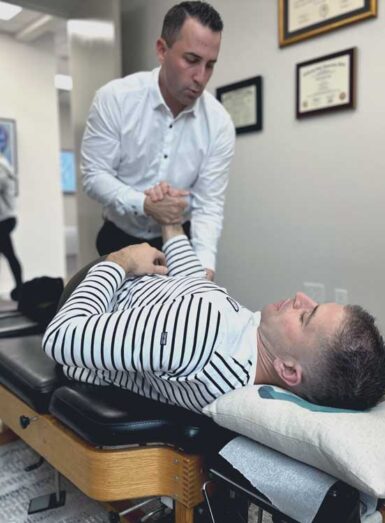
Assessment without a plan is just information. The next step is turning objective findings into action. For some people, that may include specific chiropractic adjustments designed to improve spinal alignment and joint motion. For others, the focus may be mobility work, postural retraining, corrective exercises, ergonomic changes, or movement coaching that supports the care plan.
The best plan is not necessarily the most intense one. It is the one that matches the severity and complexity of your findings, your schedule, and your goals. A person with a recent flare-up and mild restriction may need a different approach than someone managing years of compensatory patterns after multiple injuries.
Consistency matters because your body has learned its current pattern over time. One adjustment or one perfect workout cannot always reverse a pattern reinforced by thousands of workdays, training sessions, and compensations. That is not a reason to feel discouraged. It is a reason to choose care that measures progress and gives you a path forward.
Why Objective Progress Changes the Experience
When your care is based only on how you feel that day, it is easy to lose momentum. Symptoms fluctuate. You may feel great after a weekend off, then stiff after a deadline-heavy week or a hard training block. Subjective feedback matters, but it is stronger when paired with measurable changes in movement, posture, and spinal function.
Reassessments create accountability. They show whether your range of motion is improving, whether your posture is becoming more balanced, and whether the plan needs to be adjusted. They also give you evidence that your effort is producing change, which can be especially powerful for people who have spent years being told to simply manage their pain.
Your body is built for movement, adaptation, and recovery. An adult posture assessment is not about chasing perfection or forcing yourself into a rigid position. It is about identifying what is holding you back so you can move with more freedom, train with greater confidence, and reclaim a body that supports the life you are determined to live.
Mōtus Chiropractic is a top-rated chiropractor located in Austin, TX. Dr. Mike Isseks offers more than 15 years experience helping his patients alleviate pain and Move Consciously. To schedule a visit, click here.
RECLAIM YOUR LIFE
Rebuild your body and reduce your pain with our progressive technology, proven alternative methods of care, and integrative chiropractic experience.

“Dr. Mike improved the mobility of my spine measurably. The whole team is incredibly flexible and helpful to work with. Everything is fast and easy.”

Author, biohacker, and founder of Bulletproof Nutrition

“Dr. Mike and the team at Mōtus are top notch. The adjustments are specific and the analysis is beyond thorough. If you’re in Austin, this is the spot for high-level Chiropractic care.”
– Adrian Grenier
Actor and Film Producer

ABOUT DR. MIKE ISSEKS
Dr. Mike has been a practicing chiropractor for more than 15 years. He is a graduate of California State University at Chico and received his Doctor of Chiropractic degree from Life Chiropractic College West. He specializes in corrective care chiropractic, improving posture, as well as optimizing spinal motion to help uncover the best version of those he serves.
STAY IN THE KNOW
Get cutting-edge health tips, updates, and event notifications...
By entering your email above and clicking “Sign-Up,” you agree to receive occasional emails from Mōtus Chiropractic.
VISIT US
Trio at Menchaca Business Park
Ample free parking in the front lot
HOURS
Monday, Tuesday, Thursday
8:30 am – 12 pm
2:30 pm – 6 pm
Wednesday
12 pm – 5 pm
REACH US
(512) 777-2680
hello@motusatx.com
STAY IN THE KNOW
Get cutting-edge health tips, updates, and event notifications...
By entering your email above and clicking “Sign-Up,” you agree to receive occasional emails from Mōtus Chiropractic.
Copyright 2022, Mōtus Chiropractic. All rights reserved.