
THE MŌTUS BLOG
July 6, 2026
How Spinal Correction Improves Mobility
If your hips feel tight, your neck always seems to catch, or your lower back limits how you train, work, or sleep, the issue may not be a lack of stretching. It may be structural. Understanding how spinal correction improves mobility starts with a simple truth: when your spine is misaligned and not moving well, the rest of your body has to compensate.
That compensation is where so many active adults get stuck. They foam roll more, force deeper stretches, switch workout programs, and blame age, stress, or long hours at a desk. But if the spine is distorted, compressed, or restricted, mobility work alone often becomes maintenance for a problem that was never fully addressed.
Why mobility is not just about flexibility
A lot of people use mobility and flexibility like they mean the same thing. They do not. Flexibility is about muscle length. Mobility is about controlled movement through a joint's available range of motion. That distinction matters.
You can be flexible and still move poorly. You can touch your toes and still have a spine that rotates unevenly, a pelvis that compensates under load, or a neck that has lost healthy curve and motion. Real mobility depends on alignment, joint mechanics, muscular balance, and nervous system coordination working together.
The spine sits at the center of all of it. It houses and protects the nervous system, distributes force, and helps coordinate movement between the upper and lower body. When spinal joints lose proper motion or shift out of healthy alignment, movement quality changes everywhere else. The body is smart, but it is not magical. It will find a workaround. That workaround is usually what becomes tightness, instability, pain, or reduced performance.
How spinal correction improves mobility at the source
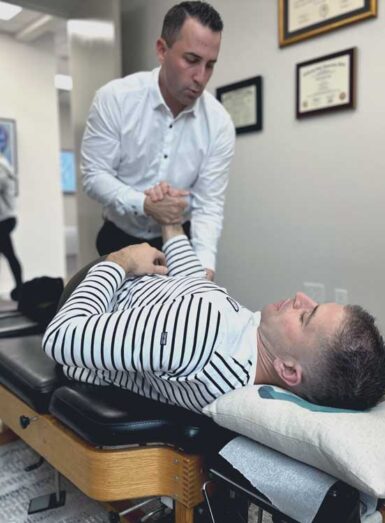
Corrective spinal care is different from chasing symptoms. The goal is not to provide a quick crack and send you back into the same dysfunction. The goal is to identify where movement has broken down, why compensation patterns developed, and what needs to change to restore more normal mechanics.
When spinal alignment improves, several things start to happen.
First, restricted joints can begin to move more normally. A segment of the spine that is not gliding or rotating well creates stress above and below it. Restore function there, and the body no longer has to steal motion from the wrong places.
Second, muscle tension often starts to change. Tight muscles are not always the main problem. Sometimes they are guarding an unstable or misaligned area. If your body senses poor support or distorted joint positioning, it creates tension to protect you. That is why stretching can feel good for an hour and then do nothing lasting. Once the underlying spinal dysfunction is addressed, the guarding response can ease.
Third, posture improves. That is not about standing straighter for appearances. Better posture changes load distribution. It can reduce compression in the spine, free up shoulder and hip mechanics, and make everyday movement less costly. Walking, reaching, squatting, turning your head, and even breathing can feel easier when the structure underneath those movements is better organized.
Finally, the nervous system gets a better signal. If the spine is under chronic stress, motion is restricted, and biomechanics are distorted, your brain receives faulty information about where your body is in space and how safely it can move. Corrective care helps clean up that feedback loop. Better input often leads to better control.
The compensation patterns most people miss
This is where generic care falls short. The body rarely complains exactly where the problem begins.
A stiff thoracic spine can show up as shoulder pain during pressing or overhead work. A forward head posture can contribute to neck tension, headaches, and reduced rotation while driving. Loss of lumbar curve can change pelvic mechanics, tighten the hip flexors, and make hamstrings feel chronically short. None of those patterns are random.
If you only treat the area that hurts, you may get temporary relief. If you correct the spinal distortion driving the compensation, mobility has a real chance to improve in a lasting way.
That is why objective testing matters. Range-of-motion analysis, postural evaluation, and when clinically appropriate, pre- and post-motion imaging can reveal whether a joint is actually moving differently or just feeling different for a short window. Serious patients should expect more than guesswork.
How spinal correction improves mobility in daily life
The gains are not limited to pain reduction. For high-performing adults, mobility is about access. It is your ability to train hard, recover well, sit through meetings without your back locking up, play with your kids, travel without stiffness, and stay physically capable as life gets more demanding.
When spinal function improves, people often notice that basic movements stop feeling negotiated. Rotation becomes smoother. Stride length can improve. Deep breathing feels less restricted. Getting out of bed, getting under a barbell, or sitting at a laptop for two hours no longer creates the same level of backlash.
That said, results depend on the person. If someone has severe degeneration, long-standing postural collapse, old injuries, or years of compensation, progress may take time. Corrective care is not a shortcut. It is a process. But for the right patient, it is the process that finally makes the other healthy habits work better.
Spinal correction and athletic performance
Mobility is performance currency. If your spine does not move well, force transfer gets sloppy. That matters whether you run, golf, lift, cycle, climb, or spend your weekends on Austin trails trying to stay strong and pain-free.
Athletes and active professionals often assume they only need stronger glutes, more core work, or better recovery tools. Sometimes that is true. But if spinal mechanics are off, those inputs can hit a ceiling.
A restricted mid-back can limit overhead mechanics and affect pressing strength. Pelvic imbalance can change squat depth, gait efficiency, and rotational power. Cervical dysfunction can influence posture, breathing strategy, and upper-body tension. Correcting the spine does not replace training. It helps create a body that can express training more effectively.
That is a major difference. You are not just chasing pain relief. You are building a better platform for movement.
What good corrective care should include
If you are serious about changing mobility, stop settling for generic treatment plans. A premium corrective approach should begin with a thorough assessment, not assumptions.
That means looking at posture, spinal curves, joint motion, movement quality, and the specific patterns that show up in your daily life or training. It also means tracking progress with measurable benchmarks instead of relying only on whether you felt looser after one visit.
The care plan itself should be individualized. Some patients need focused spinal adjustments over time to restore alignment and motion. Others also need postural retraining, targeted exercises, soft tissue support, and changes in ergonomics or movement habits. Usually, the answer is not one thing. It is the right combination, in the right sequence, based on how your body responds.
This is one reason people who are frustrated with mainstream care often do well in a corrective model. They are not looking to mask symptoms. They want to know what is actually wrong, whether it can improve, and what it will take to get there.
How to know if your mobility problem may be spinal
Not every mobility issue starts in the spine, but many do. If your stiffness keeps returning, one side always feels different from the other, stretching gives short-lived relief, or pain shows up after sitting, standing, or training in predictable ways, spinal dysfunction deserves a closer look.
You should also pay attention if your posture has changed, your range of motion has gradually declined, or your body feels less coordinated than it used to. Those are not small things. They are often early signs that your structure and movement quality are drifting in the wrong direction.
At Mōtus Chiropractic, that is exactly where a more serious conversation begins - with objective findings, not vague wellness talk. Because when you can see what is happening, you can finally make decisions that move your body forward.
Mobility is not something you lose and just have to accept. In many cases, it is something you can restore when the right structure, the right strategy, and the right level of commitment come together. Your body is built to move well. If it is not, that is your cue to stop managing the limitation and start correcting the cause.
Mōtus Chiropractic is a top-rated chiropractor located in Austin, TX. Dr. Mike Isseks offers more than 15 years experience helping his patients alleviate pain and Move Consciously. To schedule a visit, click here.
RECLAIM YOUR LIFE
Rebuild your body and reduce your pain with our progressive technology, proven alternative methods of care, and integrative chiropractic experience.
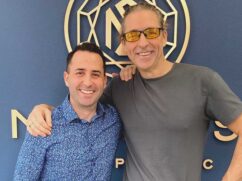
“Dr. Mike improved the mobility of my spine measurably. The whole team is incredibly flexible and helpful to work with. Everything is fast and easy.”

Author, biohacker, and founder of Bulletproof Nutrition

“Dr. Mike and the team at Mōtus are top notch. The adjustments are specific and the analysis is beyond thorough. If you’re in Austin, this is the spot for high-level Chiropractic care.”
– Adrian Grenier
Actor and Film Producer

ABOUT DR. MIKE ISSEKS
Dr. Mike has been a practicing chiropractor for more than 15 years. He is a graduate of California State University at Chico and received his Doctor of Chiropractic degree from Life Chiropractic College West. He specializes in corrective care chiropractic, improving posture, as well as optimizing spinal motion to help uncover the best version of those he serves.
STAY IN THE KNOW
Get cutting-edge health tips, updates, and event notifications...
By entering your email above and clicking “Sign-Up,” you agree to receive occasional emails from Mōtus Chiropractic.

VISIT US
Trio at Menchaca Business Park
8701 Menchaca Road
Building 3, Unit 101
Austin, TX 78748
Ample free parking in the front lot
HOURS
Monday, Tuesday, Thursday
8:30 am – 12 pm
2:30 pm – 6 pm
Wednesday
12 pm – 5 pm
REACH US
(512) 777-2680
hello@motusatx.com
STAY IN THE KNOW
Get cutting-edge health tips, updates, and event notifications...
By entering your email above and clicking “Sign-Up,” you agree to receive occasional emails from Mōtus Chiropractic.
Copyright 2022, Mōtus Chiropractic. All rights reserved.