
THE MŌTUS BLOG
June 15, 2026
Can Chiropractic Improve Posture?
If you catch yourself pulling your shoulders back ten times a day only to slump again by lunch, you already know the real question is not just can chiropractic improve posture - it’s why posture keeps drifting in the first place. Most people are not dealing with a discipline problem. They are dealing with a structural and movement problem.
That distinction matters. You can remind yourself to “sit up straight” all day long, but if your spine is restricted, your muscles are compensating, and your nervous system has adapted to a distorted position, willpower won’t hold for long. Posture is not a pose. It is a reflection of how your body is functioning.
Can chiropractic improve posture in a meaningful way?
Yes, chiropractic can improve posture, but not in the simplistic way many people assume. A quick adjustment may help you feel more upright for a short period. Real postural change usually happens when chiropractic care is part of a corrective strategy that addresses spinal alignment, joint motion, muscle imbalance, and the habits that keep pulling your body out of position.
That is where many people get frustrated with mainstream approaches. They are told to stretch more, strengthen their core, or buy another ergonomic chair. Those things can help, but they often miss the root issue. If the spine is not moving well, if the head is consistently translating forward, or if one region is compensating for dysfunction somewhere else, the body will keep returning to the same stressed pattern.
Posture improves when the underlying mechanics improve. That takes more than symptom relief.
Why posture gets worse even when you try hard to "self correct"
Poor posture rarely comes from laziness. More often, it develops because your body adapts to repeated stress. Long hours at a desk, heavy training, old injuries, driving, parenting, looking down at a phone, and chronic tension all teach the body to settle into positions that eventually stop feeling wrong.
Once that adaptation becomes normal, your muscles and joints start working around it. The chest may tighten, the upper back may stiffen, the neck may overwork, and the low back may absorb force it was never meant to handle alone. Over time, that can show up as headaches, neck pain, shoulder tension, low back pain, reduced mobility, shallow breathing, and even fatigue.
This is why “good posture” is not mainly an aesthetic goal. It is a performance and longevity issue. When your frame is off, your movement efficiency drops. You waste energy. You compensate. You wear down tissues faster.
What chiropractic actually changes
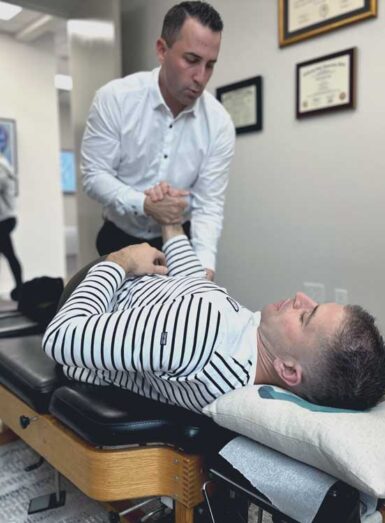
Chiropractic care is designed to improve spinal and joint function. When a chiropractor identifies areas of restriction, misalignment, or abnormal motion and addresses them, the body often gains a better foundation for upright, balanced posture.
That foundation matters because posture is dynamic. You are not a statue. You walk, rotate, train, sit, breathe, and carry stress. If the spine cannot move properly through those demands, the body creates shortcuts. Those shortcuts become your default posture.
A precise chiropractic adjustment can help restore motion to restricted segments, reduce abnormal stress on surrounding tissues, and improve the way the nervous system coordinates movement. In practical terms, that may mean your shoulders sit more evenly, your head rests less forward, your thoracic spine extends more naturally, and your body no longer has to fight so hard to stay upright.
But there is an honest caveat here. If care stops at occasional relief-based adjustments, posture change may be limited. Lasting improvement usually requires a plan.
The difference between temporary relief and corrective care
This is where the question can chiropractic improve posture gets more nuanced. It can, but the type of care matters.
Relief care focuses on reducing pain in the moment. Corrective care focuses on changing the conditions that created the problem. For someone with postural distortion, that difference is everything.
Corrective care starts with measurement. Not guesswork. Not a five-minute conversation followed by a generic adjustment. A more advanced approach uses objective findings to understand how the spine is aligned, how it moves, where compensation is happening, and how severe the pattern has become. That may include postural analysis, range-of-motion testing, orthopedic and neurological examination, and when clinically appropriate, pre- and post-motion X-ray studies.
Once those findings are clear, the treatment plan can be individualized. Some people need focused spinal correction. Others need movement restoration, home exercises, traction strategies, or support for longstanding muscular imbalance. The point is not to chase pain. The point is to change the structure and function that keep recreating it.
That is why premium corrective practices tend to get stronger posture outcomes than one-size-fits-all care. They are not just trying to make you feel better. They are trying to help your body hold a better position on its own.
Signs your posture problem may respond well to chiropractic
If your posture shifts with effort but never holds, that is often a clue that your body lacks structural support. If you have recurring neck and shoulder tension, frequent headaches, mid-back stiffness, uneven hips, low back tightness after sitting, or reduced rotation during workouts, there may be an underlying mechanical issue worth assessing.
Many active adults also notice that performance starts to plateau when posture declines. Running form gets sloppy. Lifts feel asymmetrical. Recovery takes longer. Breathing during training feels restricted. This is not vanity. This is biomechanics.
Chiropractic may be especially useful when posture problems are tied to spinal restrictions, chronic compensation patterns, old injuries, or prolonged desk stress. It may be less effective as a stand-alone solution if the issue is driven primarily by neurological disease, advanced structural degeneration, or unaddressed strength deficits. Again, it depends.
What to expect if you want lasting posture change
If your goal is real change, expect a process rather than a miracle. The body has memory. If you have spent years in a forward head posture or rounded-shoulder pattern, your tissues and movement habits will not fully reset overnight.
A strong plan usually includes three elements. First, specific chiropractic adjustments to restore mobility and reduce abnormal joint stress. Second, targeted corrective exercises or mobility work to reinforce better movement patterns. Third, consistency over time so the new pattern becomes more natural than the old one.
This is where commitment matters. Ambitious people often want the fastest route, but posture correction rewards consistency more than intensity. Small changes repeated with precision outperform random effort every time.
At a practice like Mōtus Chiropractic in Austin, the emphasis is not on giving you another temporary reset and sending you back into the same breakdown pattern. It is on measurable change - testing, retesting, and building a personalized care plan that helps your body move and stack better under real life demands.
What chiropractic cannot do on its own
Let’s be clear. Chiropractic is powerful, but it is not magic. If you spend ten hours a day collapsed over a laptop, never strengthen your upper back, ignore your sleep position, and expect one adjustment a month to override all of that, you are asking too little of yourself and too much of the treatment.
The best results happen when care and personal responsibility work together. Your environment matters. Your training matters. Your recovery matters. So do your habits when no one is watching.
That should not feel discouraging. It should feel empowering. You are not stuck with the posture you have now. But you do need an approach that respects how the body actually changes.
Why better posture is about more than looking confident
Yes, improved posture can change how you look. You may appear taller, stronger, and more composed. But that is the shallowest benefit.
The deeper win is efficiency. Better posture often means better load distribution, cleaner movement mechanics, less unnecessary muscular tension, and improved breathing capacity. For professionals, that can mean more energy through the day. For athletes and active adults, it can mean better output and fewer setbacks. For anyone dealing with recurring pain, it can mean finally stopping the cycle of short-term relief followed by the same old problem.
That is the real standard. Not whether you can force your shoulders back for a photo, but whether your body can support alignment without constant struggle.
If you have been stretching, foam rolling, and buying ergonomic upgrades while your posture keeps slipping, stop settling for surface-level fixes. The right chiropractic approach can absolutely help improve posture, but only when it is aimed at the root cause, backed by objective findings, and carried out with enough consistency to create change that lasts.
Your posture is telling the truth about how your body is functioning. Listen to it, and you can start rebuilding from the source.
Mōtus Chiropractic is a top-rated chiropractor located in Austin, TX. Dr. Mike Isseks offers more than 15 years experience helping his patients alleviate pain and Move Consciously. To schedule a visit, click here.
RECLAIM YOUR LIFE
Rebuild your body and reduce your pain with our progressive technology, proven alternative methods of care, and integrative chiropractic experience.

“Dr. Mike improved the mobility of my spine measurably. The whole team is incredibly flexible and helpful to work with. Everything is fast and easy.”

Author, biohacker, and founder of Bulletproof Nutrition

“Dr. Mike and the team at Mōtus are top notch. The adjustments are specific and the analysis is beyond thorough. If you’re in Austin, this is the spot for high-level Chiropractic care.”
– Adrian Grenier
Actor and Film Producer

ABOUT DR. MIKE ISSEKS
Dr. Mike has been a practicing chiropractor for more than 15 years. He is a graduate of California State University at Chico and received his Doctor of Chiropractic degree from Life Chiropractic College West. He specializes in corrective care chiropractic, improving posture, as well as optimizing spinal motion to help uncover the best version of those he serves.
STAY IN THE KNOW
Get cutting-edge health tips, updates, and event notifications...
By entering your email above and clicking “Sign-Up,” you agree to receive occasional emails from Mōtus Chiropractic.

VISIT US
Trio at Menchaca Business Park
Ample free parking in the front lot
HOURS
Monday, Tuesday, Thursday
8:30 am – 12 pm
2:30 pm – 6 pm
Wednesday
12 pm – 5 pm
REACH US
(512) 777-2680
hello@motusatx.com
STAY IN THE KNOW
Get cutting-edge health tips, updates, and event notifications...
By entering your email above and clicking “Sign-Up,” you agree to receive occasional emails from Mōtus Chiropractic.
Copyright 2022, Mōtus Chiropractic. All rights reserved.