
THE MŌTUS BLOG
August 7, 2026
Sports Recovery Chiropractor Austin for Athletes
A hard training block should leave you stronger, not increasingly restricted. If your hips feel locked after runs, your neck tightens after rides, or your shoulder keeps limiting your lifts, a sports recovery chiropractor Austin athletes trust can help identify what recovery tools alone may be missing: the structural and movement patterns driving the overload.
Austin is full of driven people who train through discomfort because they do not want to lose momentum. But pain that repeatedly returns is not a badge of discipline. It is feedback. The body is asking for a better strategy than another round of stretching, foam rolling, anti-inflammatories, or a quick adjustment that fades by next week.
Recovery Is More Than Feeling Looser
Recovery is often treated as a checklist: sleep more, hydrate, eat protein, use the massage gun, and take a rest day. Those habits matter. They can reduce soreness, support tissue repair, and improve training readiness. Yet they cannot always correct the movement dysfunction that keeps loading the same area.
Consider the runner with recurring calf tightness. The calf may be doing more than its share because the ankle lacks motion, the pelvis is not moving well, or the spine is not providing stable communication to the muscles below it. Treating the calf may offer relief. Finding why it is constantly overworking creates the opportunity for lasting change.
That distinction matters for active adults. You are not looking to simply get through your next workout. You want to keep training, competing, working, traveling, parenting, and living at a high level without constantly negotiating with your body.
What a Sports Recovery Chiropractor in Austin Should Assess
A meaningful recovery plan starts before treatment. If a provider does not understand how you move, where your body is compensating, and what your training demands require, the care can become generic fast.
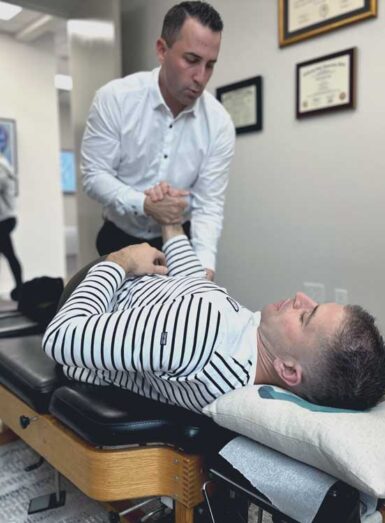
At Mōtus Chiropractic, the focus is not limited to where symptoms show up. A thorough approach can include a health history, postural evaluation, range-of-motion testing, spinal motion analysis, and when clinically appropriate, pre- and post-motion X-ray studies. These tools help create a clearer picture of alignment, joint function, and areas of restricted or excessive movement.
That objective baseline changes the conversation. Instead of guessing why your low back flares after deadlifts, you can examine whether limited hip motion, pelvic imbalance, poor spinal mechanics, or repetitive loading patterns may be contributing. Instead of assuming headaches are just stress, you can assess cervical posture and mobility.
No test is valuable in isolation. The value comes from connecting the findings to your life: the desk hours before your evening workout, the mileage you build each week, the old ankle sprain you never fully addressed, or the strength program that has outpaced your current movement capacity.
Symptoms Are Often the Last Signal
Pain is useful, but it is not always an early warning. By the time discomfort is intense enough to interrupt training, your body may have been compensating for months or years. A shoulder can tolerate poor thoracic mobility until volume increases. A low back can compensate for weak hip mechanics until a heavy lift or long drive pushes it past capacity.
This is why symptom-only care can be frustrating. You may feel better temporarily while the underlying pattern remains untouched. Corrective chiropractic care aims to address the conditions that keep pulling you back into the same cycle.
The Difference Between Relief Care and Corrective Care
There is nothing wrong with wanting relief. When your neck is seized up before a race or your back is limiting sleep, reducing pain matters. But relief should be the beginning of a plan, not the finish line.
Relief-focused care often centers on making you feel better in the moment. Corrective care asks a larger question: What needs to change so this issue is less likely to control your next training season?
The answer may include specific chiropractic adjustments to improve spinal motion and reduce nervous-system interference. It may include targeted mobility work, posture changes, training modifications, or guidance around recovery habits. It depends on your examination findings, injury history, goals, and how consistently your body responds to care.
A customized plan should also have checkpoints. If progress cannot be observed, discussed, and adjusted, it is difficult to know whether the strategy is working. Measurable change can include improved range of motion, better posture, fewer flare-ups, more comfortable training, or greater confidence in movements that once felt guarded.
Your Training Is Part of the Clinical Picture
A serious recovery plan does not ask you to abandon movement every time something hurts. Nor does it tell you to push through every signal. It respects the difference between productive training stress and a pattern that is breaking down.
For some people, the right move is temporarily reducing intensity while restoring mobility and control. For others, it may be changing exercise selection, improving technique, or creating more recovery between demanding sessions. The goal is not fragility. It is resilience.
That is especially relevant for Austin’s runners, cyclists, CrossFit athletes, recreational lifters, tennis players, and busy professionals who fit training around a packed schedule. The demands may differ, but the principle is the same: your body needs enough alignment, mobility, stability, and recovery capacity to meet the load you place on it.
When Chiropractic Care May Fit Your Recovery Plan
Sports recovery chiropractic care can be useful when pain, stiffness, or reduced movement repeatedly affects your ability to train and recover. Common reasons active patients seek care include recurring neck or back discomfort, headaches, hip tightness, shoulder restrictions, reduced rotational mobility, lingering effects of old injuries, and postural strain from long workdays.
It can also make sense when nothing is dramatically wrong, but performance feels limited. Maybe your squat depth has changed. Maybe you need longer to recover from sessions that once felt manageable. Maybe you notice one-sided tightness every time you run. Those are not details to dismiss. They are data.
There are trade-offs and limits. Chiropractic care is not a substitute for emergency evaluation, surgery when surgery is necessary, or medical management of serious conditions. Sudden severe weakness, loss of bladder or bowel control, significant trauma, chest pain, fever with severe pain, or unexplained symptoms require prompt medical attention. A responsible provider knows when collaboration or referral is the right call.
Stop Chasing the Same Flare-Up
The mainstream approach often trains people to wait until pain becomes disruptive, suppress it, and return to the same habits. That is not recovery. That is postponement.
A better approach is to take ownership early. Pay attention to the patterns. Get clear on how your spine and joints are moving. Ask for objective answers, not vague reassurance. Build a plan that respects both your immediate goals and the long game.
Your body is not asking you to settle for less training, less energy, or less confidence. It is asking for the right inputs. When you address the root of restricted movement instead of repeatedly chasing the symptom, you give yourself a real chance to reclaim performance that lasts. When you're looking for that chiropractor in South Austin, Mōtus is it!
Mōtus Chiropractic is a top-rated chiropractor located in Austin, TX. Dr. Mike Isseks offers more than 15 years experience helping his patients alleviate pain and Move Consciously. To schedule a visit, click here.
RECLAIM YOUR LIFE
Rebuild your body and reduce your pain with our progressive technology, proven alternative methods of care, and integrative chiropractic experience.
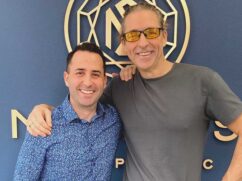
“Dr. Mike improved the mobility of my spine measurably. The whole team is incredibly flexible and helpful to work with. Everything is fast and easy.”

Author, biohacker, and founder of Bulletproof Nutrition

“Dr. Mike and the team at Mōtus are top notch. The adjustments are specific and the analysis is beyond thorough. If you’re in Austin, this is the spot for high-level Chiropractic care.”
– Adrian Grenier
Actor and Film Producer

ABOUT DR. MIKE ISSEKS
Dr. Mike has been a practicing chiropractor for more than 15 years. He is a graduate of California State University at Chico and received his Doctor of Chiropractic degree from Life Chiropractic College West. He specializes in corrective care chiropractic, improving posture, as well as optimizing spinal motion to help uncover the best version of those he serves.
STAY IN THE KNOW
Get cutting-edge health tips, updates, and event notifications...
By entering your email above and clicking “Sign-Up,” you agree to receive occasional emails from Mōtus Chiropractic.

VISIT US
Trio at Menchaca Business Park
Ample free parking in the front lot
HOURS
Monday, Tuesday, Thursday
8:30 am – 12 pm
2:30 pm – 6 pm
Wednesday
12 pm – 5 pm
REACH US
(512) 777-2680
hello@motusatx.com
STAY IN THE KNOW
Get cutting-edge health tips, updates, and event notifications...
By entering your email above and clicking “Sign-Up,” you agree to receive occasional emails from Mōtus Chiropractic.
Copyright 2022, Mōtus Chiropractic. All rights reserved.