
THE MŌTUS BLOG
September 1, 2026
What Long Term Chiropractic Results Look Like
A pain-free morning can feel like proof that the problem is solved. Then a long day at your laptop, a heavy deadlift, or one stressful week brings the stiffness right back. That cycle is exactly why long term chiropractic results require more than an adjustment when discomfort flares. They require a plan designed around how your spine moves, how you load your body, and what has been driving the pattern in the first place.
For active adults, temporary relief is not the goal. You want to train without guarding, work without ending every day with tension across your shoulders, turn your head without restriction, and trust your body to keep up with the life you are building. That is a different standard of care.
Why short-term relief is not the same as lasting change
A chiropractic adjustment may help reduce joint restriction, improve motion, and provide relief for some people. That matters. But relief alone does not tell you whether the underlying movement pattern has changed.
If your neck pain is connected to years of forward-head posture, limited upper-back motion, old injuries, poor recovery, or a work setup that keeps your body in the same compressed position for ten hours a day, one good visit cannot erase every contributing factor. The same is true for recurring low-back pain in someone who trains hard but lacks hip mobility, trunk control, or a sustainable recovery routine.
Stop settling for the false choice between suffering through symptoms and chasing an endless series of quick fixes. Corrective chiropractic care asks a more useful question: what needs to change so your body can function differently over time?
That answer is personal. Two people can arrive with the same complaint - headaches, low-back tightness, numbness, or reduced range of motion - and need very different care plans. Symptoms are signals. They are not a complete diagnosis or a personalized strategy.
Long term chiropractic results start with measurable baselines
Lasting progress needs a starting point you can measure. A thorough evaluation should go beyond asking where it hurts. It should examine posture, spinal mobility, joint function, movement compensation, health history, daily demands, and the activities you want to return to or improve.
At Mōtus Chiropractic, this process may include advanced range-of-motion diagnostics and pre-motion X-ray studies when clinically appropriate. These tools can help document how the spine is positioned and how well specific regions move. They do not replace clinical judgment, and imaging is not necessary for every patient. Used responsibly, however, objective testing can move the conversation beyond guesswork.
A meaningful baseline allows you and your doctor to track whether care is producing functional change. Can you rotate farther? Has your posture improved? Are you moving with less compensation? Are headaches less frequent? Is your training recovery more predictable? Those outcomes are more valuable than a vague sense that you "felt better for a few days."
What progress may look like
Progress rarely follows a straight line. Early changes can include less muscle guarding, easier movement, improved sleep, or fewer flare-ups. Structural and behavioral changes often take longer, especially when a pattern has been present for years.
The right timeline depends on the problem, the severity of mobility restrictions, your injury history, work and training demands, consistency with care, and how your body responds. Anyone promising identical results on an identical schedule is offering a script, not individualized healthcare.
The corrective-care difference
Corrective care is not about keeping you dependent on appointments. It is about creating enough change in spinal function, posture, and movement capacity that your body has a stronger foundation for daily life.
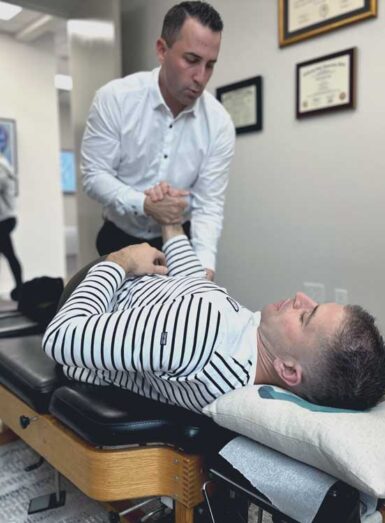
That typically involves a sequence rather than a single intervention. First, care may focus on reducing restrictions and restoring available motion. From there, the plan can progress toward improving postural awareness, strengthening new movement patterns, and helping you maintain gains outside the office. Adjustments can be part of that process, but they are not the whole process.
For a desk-bound professional, the work might include addressing cervical and upper-thoracic mobility alongside changes to workstation habits and movement breaks. For a runner or CrossFit athlete, it may mean improving spinal and hip mechanics while building a training plan that does not repeatedly overload the same limitation. The correction has to make sense in the context of your real life.
This is where self-responsibility becomes powerful. Your provider can assess, adjust, educate, and guide. But your daily position, training choices, sleep, stress load, and follow-through influence whether a new pattern becomes durable. You do not need perfection. You need a plan you can actually execute.
What can limit lasting results?
Chiropractic care is not a substitute for every kind of medical evaluation or treatment. Some pain is driven by conditions that need co-management, imaging, medication, physical therapy, specialist care, or urgent attention. New weakness, loss of bowel or bladder control, significant trauma, fever with severe spinal pain, unexplained weight loss, or pain that rapidly worsens deserves prompt medical evaluation.
Even when chiropractic care is appropriate, several factors can slow progress. Chronic stress can increase muscle tension and reduce recovery. Inconsistent appointments can interrupt an early corrective phase. Continuing to train through sharp or escalating pain can prolong irritation. A program that ignores sleep, movement, ergonomics, and workload may provide relief without changing the inputs that created the problem.
There is also a crucial trade-off: a more comprehensive plan requires time, consistency, and active participation. For someone seeking only occasional symptom support, that level of care may not be the right fit. For someone who wants to reclaim performance and build greater resilience, it can be the more honest path.
How to evaluate your own results
Do not judge your care solely by whether you feel different immediately after an appointment. Pay attention to the trend over weeks and months. Are flare-ups becoming less frequent or less intense? Is your range of motion improving? Can you sit, drive, lift, run, or sleep with less limitation? Are you relying less on compensations that used to feel normal?
Keep the focus on function. Pain scales are useful, but function is where the transformation becomes real. A lower pain score matters. So does being able to play on the floor with your kids, finish a demanding presentation without a tension headache, return to your favorite trail, or deadlift with confidence and control.
Your doctor should also reassess you. A quality plan is not something handed to you once and forgotten. It should respond to measurable change, plateaus, new goals, and the realities of your schedule. As your body improves, the plan should evolve.
Build a body that can hold the change
The most meaningful long term chiropractic results come from a partnership: skilled assessment and corrective care on one side, intentional daily action on the other. Alignment is not a passive event. It is something your body learns to support through better movement, stronger habits, and consistent attention to the signals it gives you.
If you are tired of managing the same pain cycle, ask for more than a temporary reset. Seek care that measures where you are, explains what is limiting you, and gives you a clear path forward. Your body is not asking you to lower your expectations. It is asking for a strategy worthy of the life you want to live.
Mōtus Chiropractic is a top-rated chiropractor located in Austin, TX. Dr. Mike Isseks offers more than 15 years experience helping his patients alleviate pain and Move Consciously. To schedule a visit, click here.
RECLAIM YOUR LIFE
Rebuild your body and reduce your pain with our progressive technology, proven alternative methods of care, and integrative chiropractic experience.
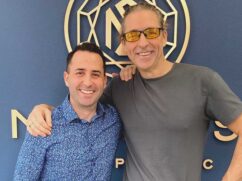
“Dr. Mike improved the mobility of my spine measurably. The whole team is incredibly flexible and helpful to work with. Everything is fast and easy.”

Author, biohacker, and founder of Bulletproof Nutrition

“Dr. Mike and the team at Mōtus are top notch. The adjustments are specific and the analysis is beyond thorough. If you’re in Austin, this is the spot for high-level Chiropractic care.”
– Adrian Grenier
Actor and Film Producer

ABOUT DR. MIKE ISSEKS
Dr. Mike has been a practicing chiropractor for more than 15 years. He is a graduate of California State University at Chico and received his Doctor of Chiropractic degree from Life Chiropractic College West. He specializes in corrective care chiropractic, improving posture, as well as optimizing spinal motion to help uncover the best version of those he serves.
STAY IN THE KNOW
Get cutting-edge health tips, updates, and event notifications...
By entering your email above and clicking “Sign-Up,” you agree to receive occasional emails from Mōtus Chiropractic.

VISIT US
Trio at Menchaca Business Park
Ample free parking in the front lot
HOURS
Monday, Tuesday, Thursday
8:30 am – 12 pm
2:30 pm – 6 pm
Wednesday
12 pm – 5 pm
REACH US
(512) 777-2680
hello@motusatx.com
STAY IN THE KNOW
Get cutting-edge health tips, updates, and event notifications...
By entering your email above and clicking “Sign-Up,” you agree to receive occasional emails from Mōtus Chiropractic.
Copyright 2022, Mōtus Chiropractic. All rights reserved.