
THE MŌTUS BLOG
June 1, 2026
Mobility Chiropractor for Athletes: Worth It?
If your squat depth disappeared, your shoulder keeps catching overhead, or your sprint mechanics feel off even though you are still training hard, pain is not always the real problem. For many active adults, the missing piece is movement quality. That is where a mobility chiropractor for athletes can make a real difference - not by chasing symptoms, but by identifying why the body stopped moving well in the first place.
Athletes are often told to stretch more, foam roll longer, or take a few days off. Sometimes that helps. Often it does not. The reason is simple: tightness is not always a flexibility problem. It can be a compensation pattern, a joint restriction, a postural issue, or a spinal dysfunction that keeps showing up as reduced range of motion, slower recovery, and performance plateaus.
What a mobility chiropractor for athletes actually does
A mobility-focused chiropractor is not just there to twist your back and send you on your way. Done correctly, this work is about restoring motion where motion has been lost and improving control where the body has been forced to compensate.
For athletes, that matters because performance depends on clean mechanics. If the spine is not moving well, the shoulders, hips, knees, and ankles often absorb stress they were never meant to handle alone. The result can look different from one person to the next. A runner may notice recurring hip tightness. A golfer may lose rotation. A CrossFit athlete may keep hitting the same overhead limitation. A tennis player may feel power leak out of the serve.
The best mobility care looks deeper than the hot spot. It asks better questions. Is the problem actually local, or is the body protecting an unstable or restricted area upstream? Is the shoulder issue really a shoulder issue, or is thoracic mobility and cervical alignment part of the picture? Is hamstring tightness really about the hamstrings, or is the pelvis and lumbar spine driving the pattern?
That distinction is everything. If you treat only the tissue that hurts, you can feel temporary relief and still stay stuck.
Why athletes lose mobility in the first place
Mobility loss is rarely random. It usually builds over time through repetition, compensation, and incomplete recovery.
Training itself can create imbalance. The same sport-specific motions that build skill can also narrow movement options. Cyclists spend hours in flexion. Lifters load predictable patterns over and over. Desk-bound professionals who also train hard bring postural stress into every workout. Add old injuries, asymmetrical movement, poor sleep, or long workdays, and the body starts choosing efficiency over quality.
At first, you only notice a little stiffness. Then range of motion starts changing side to side. Then one lift feels off. Then recovery gets slower. Eventually the body forces your attention with pain, reduced output, or recurring irritation that never fully clears.
This is why high performers get frustrated with generic advice. If you are serious about your health, you do not need another vague recommendation to rest and stretch. You need someone who can measure what is restricted, determine why it is restricted, and build a corrective plan around your actual mechanics.
The difference between symptom relief and corrective care
This is where many athletes waste time.
Quick adjustments, massage, and passive therapies can feel good. There is nothing wrong with symptom relief when used strategically. But if your care never moves beyond temporary relief, you may just be managing dysfunction instead of correcting it.
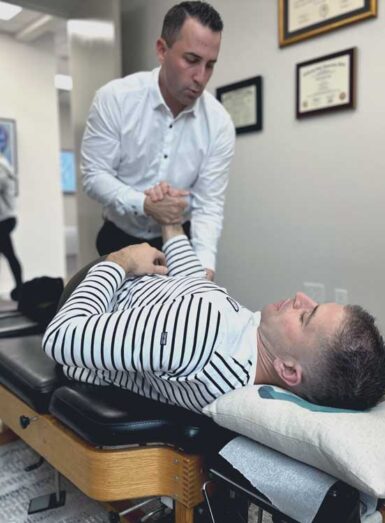
A corrective approach is different. It looks at spinal alignment, postural patterns, joint motion, and how your body functions under load. It uses objective findings instead of guesswork. That may include range-of-motion testing, movement analysis, and in some practices, pre- and post-motion imaging to see whether care is creating measurable structural change.
That level of specificity matters for athletes because performance is specific. If your body cannot rotate, stabilize, extend, or absorb force the way it should, the issue will eventually show up in training. Not always as pain. Sometimes as inconsistency, fatigue, loss of power, or the sense that your body is working harder than it should for the output you are demanding.
A mobility chiropractor for athletes should help restore function, not just create a short-lived feeling of looseness.
What to look for in a mobility chiropractor for athletes
Not every chiropractor is built for this kind of work. Some practices focus on high-volume adjustments. Some are wellness-oriented but light on diagnostics. Some are great with acute pain but less precise with performance cases.
If you are an athlete or active adult, look for someone who understands movement as a system. That means they do more than ask where it hurts. They assess posture, spinal mechanics, asymmetry, and movement quality. They explain findings clearly. They create a personalized plan. They also understand the trade-off between protecting tissue and restoring capacity.
You should be cautious of any provider who promises the same protocol for every athlete. Runners, lifters, pickleball players, swimmers, and combat athletes do not load their bodies the same way. The right care plan should reflect your sport, your training volume, your injury history, and your goals.
In a premium corrective setting, the standard is higher. You should expect objective assessment, education, and a plan that is designed to produce measurable progress over time. That is part of why practices like Mōtus Chiropractic resonate with ambitious patients in Austin. The focus is not just on getting you out of pain. It is on restoring alignment and motion so your body can perform the way it was designed to.
When chiropractic mobility care helps most
The best time to address mobility is before pain becomes the only language your body has left.
Athletes often wait until they are already compromised. But the strongest cases for mobility-focused chiropractic care are not limited to obvious injury. It can be especially useful when you keep dealing with recurring tightness, one-sided restrictions, compensation during lifts, reduced rotational capacity, or a drop in athletic confidence because movement no longer feels natural.
It also helps during transition points. Returning to training after an injury. Increasing volume for an event. Trying to stay durable while balancing work stress and intense exercise. Entering your 30s, 40s, or 50s and realizing recovery is no longer automatic. These are the moments when structure matters.
That said, it depends on the issue. Some mobility problems are soft-tissue dominant. Some are strength and motor-control issues. Some require co-management with physical therapy, orthopedics, or advanced imaging. A good chiropractor will not pretend to be the answer to everything. They will know when chiropractic care is central, when it is supportive, and when another referral is the right move.
Performance is built on alignment and control
Mobility without control is just access you cannot use. Control without mobility is force production inside a limited system. Athletes need both.
That is why spinal and joint alignment matter more than most people realize. The nervous system relies on clean input. When motion is restricted and posture is distorted, your body changes how it recruits muscle, distributes load, and protects itself. You may still be able to train hard. But hard training on top of dysfunction usually leads to compensation, not true progress.
The goal is not to become hypermobile. The goal is to move well, recover faster, and create more efficient mechanics under real-life demand. That is what translates into cleaner lifts, smoother rotation, better stride mechanics, improved overhead positioning, and less wasted energy.
For serious athletes and active adults, that shift is not cosmetic. It changes how you live in your body. Training feels more connected. Recovery becomes less dramatic. You stop negotiating with the same stubborn limitation every week.
If that sounds like a higher standard, good. It should be. Your body is not a machine to patch between workouts. It is the system that carries your ambition.
Stop settling for care that only quiets symptoms long enough for you to return to the same pattern. If your body is asking for better movement, listen early and act with intention.
Mōtus Chiropractic is a top-rated chiropractor located in Austin, TX. Dr. Mike Isseks offers more than 15 years experience helping his patients alleviate pain and Move Consciously. To schedule a visit, click here.
RECLAIM YOUR LIFE
Rebuild your body and reduce your pain with our progressive technology, proven alternative methods of care, and integrative chiropractic experience.
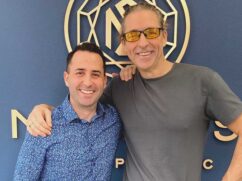
“Dr. Mike improved the mobility of my spine measurably. The whole team is incredibly flexible and helpful to work with. Everything is fast and easy.”

Author, biohacker, and founder of Bulletproof Nutrition

“Dr. Mike and the team at Mōtus are top notch. The adjustments are specific and the analysis is beyond thorough. If you’re in Austin, this is the spot for high-level Chiropractic care.”
– Adrian Grenier
Actor and Film Producer

ABOUT DR. MIKE ISSEKS
Dr. Mike has been a practicing chiropractor for more than 15 years. He is a graduate of California State University at Chico and received his Doctor of Chiropractic degree from Life Chiropractic College West. He specializes in corrective care chiropractic, improving posture, as well as optimizing spinal motion to help uncover the best version of those he serves.
STAY IN THE KNOW
Get cutting-edge health tips, updates, and event notifications...
By entering your email above and clicking “Sign-Up,” you agree to receive occasional emails from Mōtus Chiropractic.
VISIT US
Trio at Menchaca Business Park
Ample free parking in the front lot
HOURS
Monday, Tuesday, Thursday
8:30 am – 12 pm
2:30 pm – 6 pm
Wednesday
12 pm – 5 pm
REACH US
(512) 777-2680
hello@motusatx.com
STAY IN THE KNOW
Get cutting-edge health tips, updates, and event notifications...
By entering your email above and clicking “Sign-Up,” you agree to receive occasional emails from Mōtus Chiropractic.
Copyright 2022, Mōtus Chiropractic. All rights reserved.