
THE MŌTUS BLOG
July 24, 2026
How Spinal Misalignment Causes Headaches
A headache that starts at the base of your skull, climbs behind one eye, or appears after a long laptop day is not always a head problem. For many active adults, the source is lower: a neck that has lost normal motion, posture that loads the body unevenly, and muscles working overtime to compensate. Understanding how spinal misalignment causes headaches can change the question from “What can I take for this?” to “What is driving this pattern in the first place?”
That distinction matters. Temporary relief may get you through a meeting, workout, or family obligation. But if the same headache keeps returning, your body is sending a signal worth investigating.
How spinal misalignment can cause headaches
“Spinal misalignment” is often used to describe a functional problem in the spine: joints that are not moving well, altered spinal curves, postural shifts, and irritated tissues around the vertebrae. In chiropractic care, this may also be described as subluxation or segmental dysfunction. It does not mean every headache is caused by a bone being dramatically out of place. The reality is more specific and more useful.
Your upper neck is densely connected to the nervous system, muscles, ligaments, and sensory pathways that influence the head and face. When this region loses healthy movement or is repeatedly loaded in a poor position, the body adapts. Muscles tighten to create stability. Joints become irritated. Sensory input from the neck can become confused with pain signals from the head.
This is one reason neck dysfunction can contribute to cervicogenic headaches - headaches that originate in the cervical spine but are felt in the head. They often begin near the upper neck or base of the skull and may travel toward the temple, forehead, or eye. They can be one-sided, aggravated by neck movement, and accompanied by stiffness or reduced range of motion.
The relationship is not always simple. Migraine, tension-type headache, sinus issues, jaw dysfunction, sleep disruption, dehydration, hormonal changes, and stress can all play a role. Still, if your headaches consistently show up with neck pain, rounded-shoulder posture, limited rotation, or long periods at a screen, spinal function deserves more than a passing glance.
The upper neck has an outsized influence
The first few vertebrae in the neck do demanding work. They support the weight of the head, allow you to look up and down, and provide much of the rotation you use while driving, training, working, and moving through daily life. Small restrictions in this area can create a large compensation pattern.
When a joint in the upper cervical spine is not moving efficiently, nearby muscles may guard it. The suboccipital muscles, located beneath the skull, are frequent offenders. They can become shortened and overactive as they try to stabilize the head. That tension can irritate local structures and refer pain upward.
At the same time, pain signals from the upper neck converge with pathways involved in head pain. The brain can interpret the input as a headache even when the underlying irritation begins in the cervical spine. This is why rubbing your temples may feel good for a moment but fail to change the pattern.
Forward-head posture adds fuel to the problem
Modern work rarely asks your body to move the way it was designed to move. Hours spent looking down at a phone, leaning toward a screen, driving, or cycling in a sustained position can pull the head forward relative to the shoulders.
A forward head position increases the demand on the neck and upper back. The deeper stabilizing muscles may become underused while superficial muscles, including the upper trapezius and levator scapulae, take on too much work. Over time, this can reduce mobility, create trigger points, and make headaches easier to provoke.
You do not need perfect posture all day. Human bodies are built to move, not freeze in a single “ideal” position. The problem is prolonged, repetitive loading without enough movement, strength, and recovery to offset it.
Why medication alone may not change recurring headaches
Pain relievers can be appropriate for short-term symptom management, especially when recommended by your physician. But they generally do not restore a restricted neck joint, improve a collapsed posture pattern, or retrain a body that has been compensating for months or years.
That is where many people get stuck. They treat the alarm without inspecting the system that keeps setting it off. The result is a cycle of temporary relief followed by another headache after travel, a hard workout, a stressful workweek, or a few nights of poor sleep.
A root-cause approach does not promise that every headache disappears through spinal care. It does ask a better question: Is a measurable movement or structural issue contributing to your symptoms? If so, the goal is not simply to chase pain. It is to improve the conditions that make recurring pain more likely.
What a meaningful spinal assessment should examine
A generic adjustment without a clear assessment is not corrective care. If headaches are part of your health picture, the evaluation should look beyond the location of the pain.
A thorough exam may assess cervical range of motion, posture, muscle balance, neurological findings, movement compensation, daily habits, training demands, and prior injuries. Depending on your history and clinical need, imaging may also help evaluate spinal structure and movement. Pre- and post-motion X-ray studies can offer objective information about how certain spinal segments are functioning when clinically appropriate.
The point is not to create fear around every postural asymmetry. Few bodies are perfectly symmetrical, and an image alone does not explain pain. The point is to combine objective findings with your symptoms, movement capacity, and goals, then build a plan that makes sense for your actual body.
At Mōtus Chiropractic, corrective care is built around that standard: assess the pattern, identify the functional limitations, and track meaningful progress rather than relying on guesswork.
The Reality: Correcting the pattern requires more than one adjustment
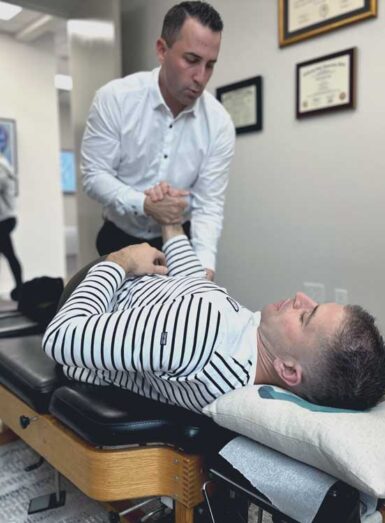
If restricted spinal motion and postural compensation have been developing for years, one visit rarely creates lasting change. A more complete plan may include specific chiropractic adjustments, mobility work, posture retraining, targeted strengthening, and practical changes to how you work, recover, and train.
The right mix depends on the person. A desk-bound founder with daily tension headaches may need different priorities than a runner whose headaches began after a fall, or a strength athlete who cannot comfortably rotate their neck under load. Personalized care is not a luxury in these cases. It is the difference between treating a symptom and addressing the system producing it.
Progress should be visible in more than a pain score. You may notice easier rotation when backing out of a parking space, less neck tension after computer work, better sleep, fewer headache days, or greater confidence during training. Those changes matter because they reflect improved capacity, not just a quieter symptom.
When a headache needs medical attention first
Not every headache belongs in a chiropractic office, and responsible care means knowing the difference. Seek urgent medical evaluation for a sudden, severe headache unlike any you have experienced; a headache after significant head trauma; or a headache with fainting, confusion, fever, stiff neck, vision loss, weakness, numbness, trouble speaking, or changes in balance.
You should also speak with your medical provider about new or worsening headaches, headaches during pregnancy or postpartum, headaches with cancer or immune-system history, or headaches that are becoming more frequent despite treatment. A careful provider will screen for red flags before considering spinal care.
Stop normalizing the signal
Recurring headaches are easy to rationalize when your life is full. You blame the screen, the stress, the workout, the travel, or another bad night of sleep. Sometimes those are real contributors. But if the pattern persists, stop settling for a cycle of pain management that leaves the underlying dysfunction untouched.
Your body is capable of adapting, healing, and performing at a higher level when it has the right input. Start by paying attention to what your headaches are paired with: neck stiffness, reduced motion, jaw tension, posture fatigue, or a specific work and training position. That awareness is often the first step toward care that restores movement instead of merely helping you endure less of it. At Mōtus, we help you get to the root cause of your headaches so you can get back to enjoying what's important in life.
Mōtus Chiropractic is a top-rated chiropractor located in Austin, TX. Dr. Mike Isseks offers more than 15 years experience helping his patients alleviate pain and Move Consciously. To schedule a visit, click here.
RECLAIM YOUR LIFE
Rebuild your body and reduce your pain with our progressive technology, proven alternative methods of care, and integrative chiropractic experience.

“Dr. Mike improved the mobility of my spine measurably. The whole team is incredibly flexible and helpful to work with. Everything is fast and easy.”

Author, biohacker, and founder of Bulletproof Nutrition

“Dr. Mike and the team at Mōtus are top notch. The adjustments are specific and the analysis is beyond thorough. If you’re in Austin, this is the spot for high-level Chiropractic care.”
– Adrian Grenier
Actor and Film Producer

ABOUT DR. MIKE ISSEKS
Dr. Mike has been a practicing chiropractor for more than 15 years. He is a graduate of California State University at Chico and received his Doctor of Chiropractic degree from Life Chiropractic College West. He specializes in corrective care chiropractic, improving posture, as well as optimizing spinal motion to help uncover the best version of those he serves.
STAY IN THE KNOW
Get cutting-edge health tips, updates, and event notifications...
By entering your email above and clicking “Sign-Up,” you agree to receive occasional emails from Mōtus Chiropractic.

VISIT US
Trio at Menchaca Business Park
Ample free parking in the front lot
HOURS
Monday, Tuesday, Thursday
8:30 am – 12 pm
2:30 pm – 6 pm
Wednesday
12 pm – 5 pm
REACH US
(512) 777-2680
hello@motusatx.com
STAY IN THE KNOW
Get cutting-edge health tips, updates, and event notifications...
By entering your email above and clicking “Sign-Up,” you agree to receive occasional emails from Mōtus Chiropractic.
Copyright 2022, Mōtus Chiropractic. All rights reserved.