
THE MŌTUS BLOG
August 14, 2026
How Motion Testing Finds Dysfunction in Your Spine
Your body can compensate for a long time before it finally demands your attention. A tight hip becomes a nagging low-back ache. A stiff neck becomes recurring headaches. A shoulder that feels “off” turns a normal workout, workday, or night of sleep into a negotiation. Understanding how motion testing finds dysfunction gives you a better answer than simply chasing the place that hurts.
Pain matters, but it is often the alarm, not the origin of the problem. A movement-based assessment looks at how your spine and joints function under real demands: bending, rotating, stabilizing, and transitioning from one position to another. It helps identify where motion is restricted, where the body is compensating, and where alignment may no longer be supporting the way you want to live.
For active adults, that distinction is not academic. It is the difference between repeatedly managing symptoms and building a body that can handle training, travel, long workdays, parenting, and the pressure of an ambitious life.
Why a Pain-Only Assessment Can Miss the Problem
If your lower back hurts, it makes sense to look at your lower back. But the body does not operate as a collection of isolated parts. Limited motion in the hips can force the lumbar spine to work overtime. A stiff upper back can shift strain into the neck and shoulders. Poor spinal mechanics can change how you stand, walk, breathe, lift, and recover.
That is why a quick symptom check can leave people stuck in a familiar cycle: temporary relief, return to normal activity, then another flare-up. The painful area may need care, but it may not be the only area that needs attention.
Motion testing shifts the question from “Where does it hurt?” to “What is not moving, stabilizing, or coordinating the way it should?” That is a more useful starting point for corrective care because it looks for contributing patterns instead of settling for a temporary reduction in discomfort.
How Motion Testing Finds Dysfunction Before It Becomes a Bigger Setback
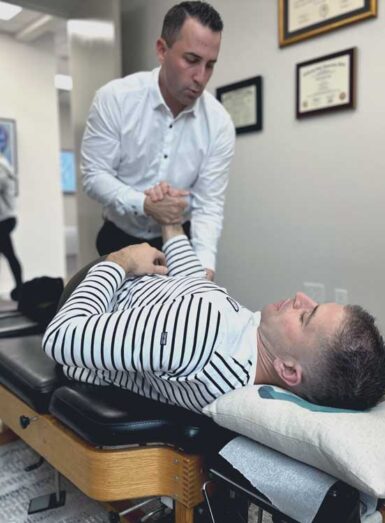
Motion testing is a hands-on and observation-based process that evaluates the quality, range, symmetry, and control of movement. It is not about forcing someone into extreme positions or judging their flexibility against an arbitrary standard. It is about seeing whether the body moves efficiently and whether a joint is doing the job it is designed to do.
During an assessment, a chiropractor may observe how you stand and walk, then evaluate spinal movement in flexion, extension, side bending, and rotation. They may assess the pelvis, hips, shoulders, and extremities because these regions influence spinal mechanics. They also evaluate how individual spinal segments move and whether certain areas feel fixed, guarded, or overloaded.
A restriction is not always painful. In fact, a joint that has stopped moving well may be silent while another region becomes irritated from doing extra work. That is one reason high performers can feel functional right up until their compensation strategy runs out.
Range of Motion Tells Part of the Story
Range of motion measures how far you can move. If turning your head to the left is noticeably more limited than turning right, that asymmetry is relevant. If bending forward causes you to hinge almost entirely from your low back while your hips barely contribute, that pattern is relevant too.
Still, more range is not automatically better. Someone who is highly mobile but lacks stability and control can have just as much dysfunction as someone who is rigid. The goal is not to become loose everywhere. The goal is purposeful motion, joint by joint, with the right balance of mobility and stability.
Movement Quality Reveals Compensation
The way you move often matters as much as the distance you move. A person might technically be able to squat, reach overhead, or rotate through the torso, yet do it with a shifted pelvis, elevated shoulder, collapsed arch, or excessive spinal twist.
Those compensations are the body’s workaround. They are intelligent in the short term because they help you complete the task. Over time, however, they can load tissues unevenly and reinforce poor movement habits. Motion testing makes those workarounds visible.
For example, limited thoracic spine rotation may cause someone to rotate excessively through the low back during golf, tennis, strength training, or even everyday tasks like backing out of a parking space. The issue is not a lack of effort. It is that the movement is being borrowed from the wrong place.
Segmental Motion Can Point to Spinal Restrictions
A global movement screen shows the broad pattern. Segmental spinal assessment looks more closely at how specific portions of the spine move relative to each other. When a spinal segment is restricted or not moving normally, it can alter posture, muscle tone, joint loading, and the information traveling through the nervous system.
In chiropractic care, this may be described as a subluxation or segmental dysfunction. The language matters less than the practical reality: a poorly functioning spinal segment can affect the system around it. It may contribute to stiffness, reduced adaptability, altered movement patterns, and recurring strain.
This assessment is not a shortcut to a diagnosis, and it should never replace a full clinical history or appropriate medical evaluation. It is one important layer of information. The strongest care plans combine what you feel, what the clinician observes, what movement testing reveals, and, when clinically appropriate, objective imaging.
Why Pre- and Post-Motion X-Rays May Matter
Static X-rays can show structure and alignment, but the body is built to move. In selected cases, pre- and post-motion X-ray studies can provide additional information about how spinal alignment changes through movement. This can help evaluate certain areas of instability, restriction, or altered biomechanics that may not be fully apparent when standing still.
Imaging is not necessary for every person with neck or back discomfort. Its value depends on your history, examination findings, symptoms, and clinical needs. A responsible provider does not order tests just to create a dramatic report. They use objective tools when those tools can clarify the problem and improve decision-making.
For people who have been told their scans are “fine” but still feel limited, this is an important distinction. A normal-looking image does not automatically explain how well you move. Function deserves to be assessed alongside structure.
From Findings to a Corrective Plan
The value of motion testing is not merely naming a dysfunction. It is using the findings to create a plan that is specific to your body and your goals.
If the assessment shows cervical restriction, forward-head posture, and poor upper-back mobility, the plan may focus on restoring spinal motion, improving postural mechanics, and reinforcing better movement habits outside the office. If the pattern involves pelvic imbalance, hip limitation, and lumbar compensation, the care strategy should account for all three rather than adjusting the painful low back in isolation.
Corrective chiropractic care may include precise adjustments, postural recommendations, movement retraining, mobility work, and lifestyle guidance. Progress should be reassessed, not assumed. As movement improves, the plan can evolve from restoring function to building resilience and maintaining results.
That measurable approach matters. You should not have to rely only on whether you happened to have a better week. Changes in range of motion, posture, movement quality, and functional tolerance offer tangible signs that your body is adapting.
What Motion Testing Cannot Do Alone
Motion testing is powerful, but it is not magic and it is not a substitute for clinical judgment. Pain can have many causes, including inflammatory conditions, nerve involvement, acute injury, or health concerns that require medical evaluation. Red flags such as significant trauma, unexplained weight loss, fever, progressive weakness, bowel or bladder changes, or severe unrelenting pain deserve prompt medical attention.
It also takes time to change patterns that have been built over years. If you sit with a forward head posture all day, train around a stiff hip, sleep poorly, and carry constant stress, one visit will not rewrite the pattern. The upside is that consistent, targeted care can create meaningful change when the plan addresses both the restriction and the habits feeding it.
Stop Settling for “It’s Just Tight”
Tightness is often a description, not an explanation. The real question is why your body keeps creating tension in the first place. Is a joint not moving? Is another area overworking? Has posture shifted your loading pattern? Are you asking your body to perform without giving it the mechanics to perform well?
At Mōtus Chiropractic, motion testing is used to move beyond guesses and toward a clearer picture of what your spine is doing. That clarity gives you a more grounded way to participate in your own healing - with measurable information, a customized strategy, and a standard of care built for lasting function.
Your body has likely been signaling for longer than you realize. Listening to those signals through movement can be the first step toward reclaiming the strength, freedom, and confidence you should not have to live without.
Mōtus Chiropractic is a top-rated chiropractor located in Austin, TX. Dr. Mike Isseks offers more than 15 years experience helping his patients alleviate pain and Move Consciously. To schedule a visit, click here.
RECLAIM YOUR LIFE
Rebuild your body and reduce your pain with our progressive technology, proven alternative methods of care, and integrative chiropractic experience.

“Dr. Mike improved the mobility of my spine measurably. The whole team is incredibly flexible and helpful to work with. Everything is fast and easy.”

Author, biohacker, and founder of Bulletproof Nutrition

“Dr. Mike and the team at Mōtus are top notch. The adjustments are specific and the analysis is beyond thorough. If you’re in Austin, this is the spot for high-level Chiropractic care.”
– Adrian Grenier
Actor and Film Producer

ABOUT DR. MIKE ISSEKS
Dr. Mike has been a practicing chiropractor for more than 15 years. He is a graduate of California State University at Chico and received his Doctor of Chiropractic degree from Life Chiropractic College West. He specializes in corrective care chiropractic, improving posture, as well as optimizing spinal motion to help uncover the best version of those he serves.
STAY IN THE KNOW
Get cutting-edge health tips, updates, and event notifications...
By entering your email above and clicking “Sign-Up,” you agree to receive occasional emails from Mōtus Chiropractic.

VISIT US
Trio at Menchaca Business Park
8701 Menchaca Road
Building 3, Unit 101
Austin, TX 78748
Ample free parking in the front lot
HOURS
Monday, Tuesday, Thursday
8:30 am – 12 pm
2:30 pm – 6 pm
Wednesday
12 pm – 5 pm
REACH US
(512) 777-2680
hello@motusatx.com
STAY IN THE KNOW
Get cutting-edge health tips, updates, and event notifications...
By entering your email above and clicking “Sign-Up,” you agree to receive occasional emails from Mōtus Chiropractic.
Copyright 2022, Mōtus Chiropractic. All rights reserved.