
THE MŌTUS BLOG
July 22, 2026
How Corrective Chiropractic Care Works
If you have been adjusted before, felt better for a day or two, and then watched the same pain, stiffness, or tension come right back, you already understand why people ask how corrective chiropractic care works. Temporary relief is not the same as structural change. If your spine keeps moving poorly, your posture keeps collapsing, or your nervous system keeps compensating, the problem has not been resolved. It has just been managed.
That is the line corrective care refuses to cross.
Corrective chiropractic care is built around a different standard. Instead of chasing symptoms visit by visit, it looks at the underlying patterns that created those symptoms in the first place. That includes spinal misalignment, restricted motion, postural distortion, muscular imbalance, and the way those issues interfere with nervous system function over time.
For active adults, that difference matters. You do not just want less pain. You want to train, work, sleep, recover, focus, and move at a higher level. You want your body to stop feeling like a project that never gets finished.
What corrective chiropractic care is really designed to do
At its core, corrective chiropractic care is designed to change structure and function, not simply mute discomfort. Pain is often the last thing to show up and the first thing to leave. That makes it a poor measurement tool if your goal is long-term healing.
A spine can lose proper alignment and motion gradually. Hours at a desk, old injuries, repetitive training patterns, stress, poor sleep, pregnancy, falls, and years of compensation can all push the body into distorted patterns. You may notice headaches, neck pain, low back tension, numbness, reduced mobility, shallow breathing, or constant fatigue. Or you may just feel off - less resilient, less powerful, less capable in your own body.
Corrective care focuses on restoring healthier spinal mechanics so the body can operate with less interference. That usually means improving joint motion, reducing pressure on irritated tissues, retraining posture, and helping the nervous system communicate more efficiently with muscles and movement patterns.
This is why corrective care typically happens over time. If a problem developed over years, expecting one or two visits to reverse it is not realistic. Fast relief can happen, but lasting change requires consistency.
How corrective chiropractic care works in practice
The process starts with a more thorough evaluation than many people expect. If a provider is serious about correction, they need to understand what is actually happening in your spine and how it is affecting your movement.
That usually begins with a detailed health history and conversation about your symptoms, habits, injuries, work demands, workouts, and goals. A person training for races has different demands than a parent carrying toddlers every day. A founder glued to a laptop has different stress patterns than a yoga teacher. Corrective care should reflect real life, not a generic treatment script.
From there, a proper exam looks at posture, spinal alignment, range of motion, orthopedic findings, muscle tension, and areas of joint restriction. In a more advanced corrective setting, objective testing may include pre- and post-motion X-rays and range-of-motion diagnostics to measure exactly how the spine is moving and where it is not. That matters because assumptions are not the same as evidence.
Once the underlying pattern is clear, the doctor builds a customized care plan. This is where people start to understand how corrective chiropractic care works differently from symptom-based treatment. The plan is not random. It is designed around the degree of spinal dysfunction, the chronicity of the problem, your age, your health status, your goals, and how much correction is realistically possible.
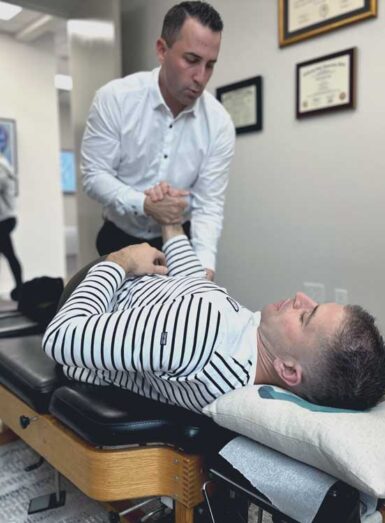
Adjustments are a core part of that process, but they are not the whole process. The adjustment is the input that helps restore motion to restricted segments and reduce dysfunctional stress in the spine. Over time, repeated precise adjustments can help the body stop reinforcing the same bad pattern. But if posture, movement habits, and muscle imbalance are left untouched, the old pattern often comes back.
That is why corrective care often includes postural recommendations, movement retraining, home exercises, stretching, and lifestyle guidance. The goal is not to make you dependent on appointments. The goal is to help your body hold the changes being made.
Why symptom relief alone is not enough
This is where many conventional approaches fall short. A person has pain, gets a quick intervention, and is told to come back if it hurts again. That model is built around recurring flare-ups, not true resolution.
The body does not work in isolated snapshots. A forward head posture can contribute to neck strain and headaches. Limited thoracic mobility can change shoulder mechanics. Pelvic imbalance can alter gait and place more stress on the low back or knees. If the full pattern is not addressed, symptoms may migrate, return, or show up in a new place.
Corrective care aims to break that cycle.
That does not mean every case can be fully reversed. Some people have advanced degeneration, prior surgery, severe disc damage, or long-standing structural changes that limit how much correction is possible. But even then, improving motion, alignment, posture, and neuromuscular control can still change quality of life in a major way. Better is still powerful, even when perfect is not on the table.
How long does corrective care take?
This is one of the most honest it-depends conversations in chiropractic.
The timeline depends on how long the problem has been there, how significant the structural changes are, how consistently you follow the plan, and how your body responds. Someone with recent posture-related neck tension may respond faster than someone with a decade of spinal degeneration and recurring low back episodes.
In general, corrective care is not a one-visit event. It is a process. Early care is often more frequent because the body needs repeated input to begin changing a deeply ingrained pattern. As stability improves, visit frequency usually changes.
That is not a sales tactic when it is done ethically. It is simple biology. Tissues adapt through repetition. Movement patterns adapt through repetition. Posture adapts through repetition. Healing is not magic. It is consistency plus the right stimulus.
For patients who are tired of short-term fixes, that trade-off is worth it. You invest more upfront because you are aiming for a different outcome.
What makes a corrective care approach credible
Not every chiropractic office that uses the word corrective is doing true corrective work. That is worth saying plainly.
A credible corrective approach should be measurable, individualized, and clearly explained. You should understand what is wrong, what the plan is trying to change, how progress is being tracked, and what your role is in the process. If care feels vague, generic, or entirely dependent on you showing up forever without clear benchmarks, ask harder questions.
Objective testing matters here. So does education. A strong doctor does not just adjust you and send you out the door. They help you understand why your body got here and what it will take to change course.
That high-accountability model tends to attract people who are ready for real results. People who want proof. People who are done outsourcing responsibility for their health.
How corrective chiropractic care works for performance, not just pain
One of the biggest misconceptions about chiropractic is that it is only for people in pain. Pain is often the entry point, but performance is where the real conversation gets interesting.
When spinal joints move better and posture improves, your body often becomes more efficient. Breathing can improve. Mobility can improve. Recovery can improve. Training form can improve. You may find it easier to rotate, hinge, squat, press, run, or simply sit through a workday without feeling wrecked by 3 p.m.
That does not mean chiropractic replaces strength training, mobility work, sleep, nutrition, or stress management. It works best alongside them. But if structural dysfunction is limiting how well your body can adapt, recover, and coordinate movement, addressing that foundation can accelerate your progress in every other area.
That is why a premium corrective practice like Mōtus Chiropractic resonates with ambitious adults in Austin. The appeal is not passive care. It is measurable change that helps you reclaim your edge.
Who tends to benefit most
The people who benefit most from corrective care are usually the ones who are done settling. They have often tried massage, stretching, pain meds, rest, or occasional adjustments, and they keep ending up in the same place. They want answers. They want a plan. They want a body that feels capable again.
That could be the runner with recurring hip and low back tightness. The entrepreneur with constant neck tension and headaches. The parent whose posture has collapsed under stress and screen time. The athlete who feels strong but moves around hidden restrictions. The adult who knows aging well is not about hoping for the best.
Corrective care is not for people looking for the fastest possible temporary fix. It is for people willing to do the work of changing the pattern.
Your body is always adapting to what you repeat. If you keep repeating compensation, tension, and collapse, that becomes your baseline. If you begin repeating alignment, motion, and smarter input, your body can build a new one. That is where real change starts.
Mōtus Chiropractic is a top-rated chiropractor located in Austin, TX. Dr. Mike Isseks offers more than 15 years experience helping his patients alleviate pain and Move Consciously. To schedule a visit, click here.
RECLAIM YOUR LIFE
Rebuild your body and reduce your pain with our progressive technology, proven alternative methods of care, and integrative chiropractic experience.
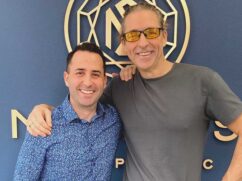
“Dr. Mike improved the mobility of my spine measurably. The whole team is incredibly flexible and helpful to work with. Everything is fast and easy.”

Author, biohacker, and founder of Bulletproof Nutrition

“Dr. Mike and the team at Mōtus are top notch. The adjustments are specific and the analysis is beyond thorough. If you’re in Austin, this is the spot for high-level Chiropractic care.”
– Adrian Grenier
Actor and Film Producer

ABOUT DR. MIKE ISSEKS
Dr. Mike has been a practicing chiropractor for more than 15 years. He is a graduate of California State University at Chico and received his Doctor of Chiropractic degree from Life Chiropractic College West. He specializes in corrective care chiropractic, improving posture, as well as optimizing spinal motion to help uncover the best version of those he serves.
STAY IN THE KNOW
Get cutting-edge health tips, updates, and event notifications...
By entering your email above and clicking “Sign-Up,” you agree to receive occasional emails from Mōtus Chiropractic.

VISIT US
Trio at Menchaca Business Park
Ample free parking in the front lot
HOURS
Monday, Tuesday, Thursday
8:30 am – 12 pm
2:30 pm – 6 pm
Wednesday
12 pm – 5 pm
REACH US
(512) 777-2680
hello@motusatx.com
STAY IN THE KNOW
Get cutting-edge health tips, updates, and event notifications...
By entering your email above and clicking “Sign-Up,” you agree to receive occasional emails from Mōtus Chiropractic.
Copyright 2022, Mōtus Chiropractic. All rights reserved.