
THE MŌTUS BLOG
July 17, 2026
Best Ways to Restore Spinal Motion and Alignment
A stiff neck after a long workday is one thing. A body that repeatedly pulls you out of training, disrupts sleep, triggers headaches, or makes simple movement feel restricted is another. The best ways to restore spinal alignment go far beyond cracking your back when it feels tight. Lasting change requires knowing what has changed in your movement, why it changed, and what your body needs to hold a healthier position under real-life demands.
For ambitious adults, alignment is not a cosmetic posture goal. It is about how well your spine moves, supports your nervous system, distributes force, and lets you show up for work, training, family, and the life you are building. Stop settling for temporary relief when your body is asking for a more complete answer.
What Spinal Alignment Actually Means
Spinal alignment does not mean forcing every curve into a perfectly straight line. A healthy spine has natural curves, and bodies vary. Functional alignment means the spine is positioned and moving in a way that supports efficient load transfer, balanced muscle activity, joint motion, and nerve function.
When that system is compromised, the symptoms do not always stay local. A forward head position may contribute to neck tension and headaches. Restricted mid-back motion can alter shoulder mechanics. Pelvic imbalance may change how your hips, knees, and feet absorb force during a run, deadlift, or walk around Austin.
Pain is useful information, but it is not a complete diagnosis. Some people have clear postural changes with little discomfort until their training volume, travel schedule, or stress load exposes the problem. Others hurt intensely because a small limitation has made surrounding muscles work overtime. That is why a meaningful plan starts with assessment, not assumptions.
The Best Ways to Restore Spinal Alignment Start With Evidence
A generic adjustment may feel good, but feeling better for a few days is not the same as changing the underlying pattern. If you want corrective results, begin with a thorough evaluation that connects symptoms to structure and movement.
Get a comprehensive movement and posture assessment
An effective assessment looks at more than the spot that hurts. It examines posture, spinal curves, range of motion, joint restrictions, muscle compensation, gait or functional movement, prior injuries, work setup, training habits, and daily stressors.
For some patients, pre- and post-motion X-ray studies can provide objective information about spinal position and how individual segments move. These studies are not necessary for everyone, and imaging should be used thoughtfully. When clinically appropriate, however, they can replace guesswork with a measurable baseline for corrective care.
The goal is not to label you as "out of alignment" and sell a standard package. The goal is to identify the specific restrictions, compensations, and structural patterns that are limiting your performance.
Use targeted corrective chiropractic care
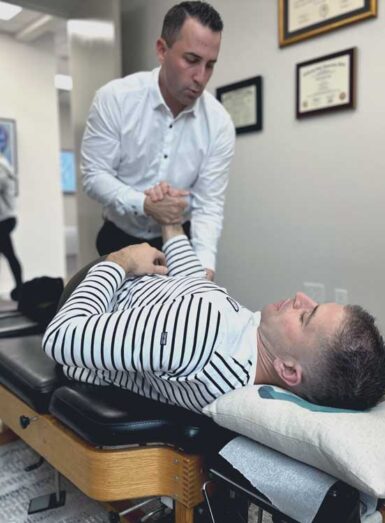
Chiropractic adjustments can help restore motion in restricted spinal joints, reduce mechanical stress, and support better communication between the brain and body. But adjustment alone is rarely the whole strategy, particularly when a pattern has been built over months or years.
Corrective care should be personalized to your findings. The frequency, techniques, exercises, and progress markers should reflect your current capacity, injury history, goals, and how your body responds. Someone preparing for a race has different needs than someone rebuilding after years at a desk. Someone with acute irritation may need a slower approach than someone whose primary issue is long-standing postural adaptation.
At Mōtus Chiropractic, corrective care is built around objective testing, spinal motion analysis, and a plan designed to create measurable change rather than a revolving door of symptom management.
Rebuild the movement your lifestyle has taken away
You cannot sit in one position for nine hours, train around restrictions, and expect one weekly appointment to carry the entire load. Your daily movement choices either reinforce the correction or pull you back toward the old pattern.
Start by restoring the mobility your body can safely use. For many people, that includes gentle neck mobility, thoracic extension and rotation, hip rotation, and controlled breathing that allows the rib cage to move. The exact exercises matter less than whether they fit your actual restrictions. Stretching aggressively into an unstable or irritated area can make things worse.
Then build strength around the new range. Deep neck flexor endurance, upper-back strength, trunk control, glute strength, and single-leg stability often matter because they help the body maintain better mechanics when life gets demanding. Mobility gives you options. Strength helps you keep them.
Change the Inputs That Keep Pulling You Out of Position
Your spine adapts to what you do repeatedly. A corrective plan that ignores your workstation, recovery habits, and training patterns will hit a ceiling.
Make your work setup support movement, not perfection
There is no single perfect desk posture to hold all day. The better target is a setup that lets you change positions easily and reduces unnecessary strain. Keep your screen near eye level, bring frequently used items within easy reach, support your feet, and avoid craning your neck toward a laptop for hours.
More importantly, interrupt static positions. Stand up, walk, rotate your upper back, and reset your shoulders every 30 to 60 minutes. These breaks do not need to become a wellness ritual that derails your day. Two minutes of intentional movement is far more valuable than another hour locked into the same posture.
Train without feeding compensation
Hard training is not the enemy. Training through a pattern your body cannot control is. If your low back takes over every squat, your neck grips during pressing, or one hip consistently shifts, your program may be reinforcing the very compensation you are trying to correct.
This does not mean you need to stop lifting, running, cycling, or playing your sport. It means you may need to adjust load, range, tempo, exercise selection, or volume while you rebuild capacity. The right modification protects momentum. It keeps you engaged without demanding that an irritated system prove something it cannot yet do well.
A smart plan also respects recovery. Poor sleep, high stress, dehydration, and inadequate nutrition do not directly "misalign" the spine, but they can increase muscle tension, slow recovery, and make pain more persistent. Alignment is physical, but healing is whole-system work.
Track Progress Beyond Pain Levels
Pain relief matters. It is just not the only metric worth tracking. A lasting corrective plan should also measure changes such as range of motion, postural endurance, training tolerance, headache frequency, sleep quality, and the ability to move through your day without guarding.
This is where many people lose ground. They stop care the moment symptoms fade, even though their movement pattern has not fully changed. Think of it like returning to heavy lifting after one good rehab session. The absence of pain can be the start of rebuilding, not proof that the work is finished.
Progress is also rarely linear. A challenging work week, a long flight, a new training block, or a poor night of sleep can temporarily flare symptoms. That does not automatically mean you are back at square one. It may mean your system exceeded its current capacity. Review the trigger, adjust the inputs, and keep building.
Know When Spinal Alignment Needs Medical Evaluation First
Not every back or neck problem belongs in a corrective-care plan without further evaluation. Seek prompt medical attention for severe trauma, new weakness, numbness that is worsening, loss of bowel or bladder control, unexplained fever, unexplained weight loss, or significant pain that does not improve or is accompanied by other concerning symptoms.
A qualified provider should also consider your health history, medications, bone health, prior surgeries, and whether imaging or referral is appropriate. High-quality chiropractic care is not about forcing every problem into the same solution. It is about choosing the right next step for the person in front of you.
Build Alignment You Can Actually Keep
Restoring spinal alignment is not about chasing a one-time adjustment or policing yourself into rigid posture. It is about creating a body that moves with more options, carries load with less compensation, and recovers faster when life gets intense.
Choose assessment over assumptions. Choose a corrective plan over random fixes. Then give that plan enough consistency to change the pattern, not just quiet the signal. Your body is capable of adapting. Give it the right direction, the right support, and a reason to hold the progress. At Mōtus Chiropractic in Austin, TX we strive for optimizing motion and alignment. Look no further for your South Austin Chiropractor and reach out to us today!
Mōtus Chiropractic is a top-rated chiropractor located in Austin, TX. Dr. Mike Isseks offers more than 15 years experience helping his patients alleviate pain and Move Consciously. To schedule a visit, click here.
RECLAIM YOUR LIFE
Rebuild your body and reduce your pain with our progressive technology, proven alternative methods of care, and integrative chiropractic experience.
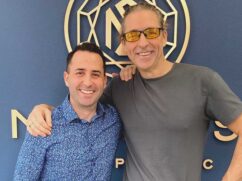
“Dr. Mike improved the mobility of my spine measurably. The whole team is incredibly flexible and helpful to work with. Everything is fast and easy.”

Author, biohacker, and founder of Bulletproof Nutrition

“Dr. Mike and the team at Mōtus are top notch. The adjustments are specific and the analysis is beyond thorough. If you’re in Austin, this is the spot for high-level Chiropractic care.”
– Adrian Grenier
Actor and Film Producer

ABOUT DR. MIKE ISSEKS
Dr. Mike has been a practicing chiropractor for more than 15 years. He is a graduate of California State University at Chico and received his Doctor of Chiropractic degree from Life Chiropractic College West. He specializes in corrective care chiropractic, improving posture, as well as optimizing spinal motion to help uncover the best version of those he serves.
STAY IN THE KNOW
Get cutting-edge health tips, updates, and event notifications...
By entering your email above and clicking “Sign-Up,” you agree to receive occasional emails from Mōtus Chiropractic.
VISIT US
Trio at Menchaca Business Park
Ample free parking in the front lot
HOURS
Monday, Tuesday, Thursday
8:30 am – 12 pm
2:30 pm – 6 pm
Wednesday
12 pm – 5 pm
REACH US
(512) 777-2680
hello@motusatx.com
STAY IN THE KNOW
Get cutting-edge health tips, updates, and event notifications...
By entering your email above and clicking “Sign-Up,” you agree to receive occasional emails from Mōtus Chiropractic.
Copyright 2022, Mōtus Chiropractic. All rights reserved.