
THE MŌTUS BLOG
August 16, 2026
Spinal Mobility Specialist Austin for Lasting Relief
Your body is built to move, adapt, train, work, and recover. When your neck will not rotate fully during a lane change, your low back tightens after a short drive, or your workout feels restricted instead of energizing, that is not simply the price of being busy. A spinal mobility specialist that Austin residents turn to should look beyond the sore spot and ask a more useful question: what is preventing your spine from moving the way it was designed to move?
Pain is often the loudest signal, but it is rarely the whole story. A stiff joint, altered spinal curve, old injury pattern, weak movement compensation, or irritation affecting the nervous system can change how your body distributes force. You may still get through your day. You may still train. But every compensation asks another area of the body to do more than its share.
For active, high-performing adults, that is not a small issue. Restricted spinal mobility can affect training quality, posture, recovery, energy, and confidence in your body. The goal should not be to repeatedly chase temporary relief. The goal is to identify what has changed, correct what can be corrected, and create a body that is more capable of carrying the life you want to live.
What a Spinal Mobility Specialist in Austin Evaluates
Spinal mobility is not the same as flexibility. Flexibility describes how far a muscle or tissue can lengthen. Mobility is your ability to control movement through a joint's available range. You can touch your toes and still have a spine that does not move well segment by segment. You can also feel "tight" when the real problem is poor stability, joint restriction, or a protective nervous-system response.
A meaningful evaluation looks at how your spine moves in multiple directions, including bending forward, extending, rotating, and side-bending. It also considers the quality of that motion. Is one side restricted? Does your pelvis shift when you bend? Does your neck compensate for a rigid upper back? Does your low back take over because your hips are not contributing enough?
Those details matter because the body is not a collection of isolated parts. A forward-head posture can alter upper-back mechanics. A restricted thoracic spine can change shoulder motion. A pelvis that is not moving well can increase demand on the lumbar spine. If care only focuses on where you feel discomfort, the original movement problem may remain untouched.
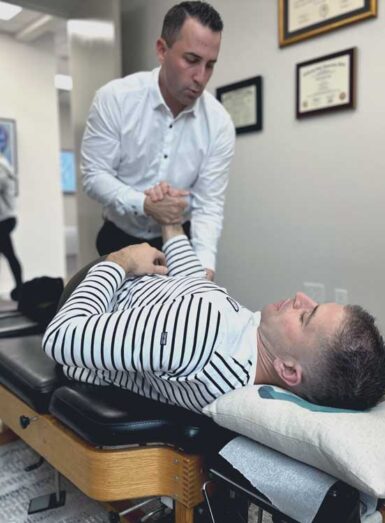
At Mōtus Chiropractic, this process can include advanced range-of-motion testing and pre- and post-motion X-ray studies when clinically appropriate. Objective testing helps move the conversation beyond guesses. It provides a clearer picture of alignment, joint motion, and structural patterns that may be influencing the way you feel and perform.
Why Stiffness Keeps Returning
Many people are caught in a frustrating cycle: pain appears, they stretch, foam roll, get a quick adjustment, or scale back training. They feel better for a few days, then the same tightness returns. That does not mean stretching or symptom relief has no place. It means neither one automatically changes the pattern that created the problem.
Mobility loss can develop gradually. Hours spent at a laptop, travel, old sports injuries, repetitive lifting, stress, poor sleep, and long periods of sitting can all influence movement habits over time. The body adapts to what it repeatedly does. If it repeatedly protects one area, avoids a certain range, or relies on asymmetrical movement, that pattern can become familiar even when it is no longer serving you.
The trade-off is that a quick intervention may reduce symptoms without building durable change. Corrective care generally requires more ownership. It asks you to follow a personalized plan, show up consistently, and give your body enough time to adapt. For someone who wants to keep hiking the Greenbelt, lifting heavy, chasing kids, leading a company, or simply waking up without bracing for discomfort, that investment can be worthwhile.
The Difference Between Relief Care and Corrective Care
Relief care has a purpose. If you are in acute pain, calming irritation and improving comfort matter. But relief is not the same as restoration.
Corrective care is built around a larger target: improved alignment, healthier motion patterns, stronger postural control, and better function over time. That may involve chiropractic adjustments, targeted movement recommendations, posture-focused strategies, and regular reassessment. The plan should reflect your actual findings, your lifestyle, and your goals, not a generic protocol handed to every person who walks through the door.
This approach also respects the fact that progress is not always linear. Someone with a recent mobility issue may respond relatively quickly. Someone with years of desk posture, previous injuries, or long-standing structural changes may need a longer runway. A credible provider will not promise a miracle timeline. They will explain the findings, establish measurable checkpoints, and adjust the plan based on how your body responds.
Signs Your Movement Problem Deserves a Closer Look
You do not need to wait until pain forces you to stop. Persistent stiffness, recurring headaches, one-sided tightness, a reduced ability to rotate your neck or torso, or soreness that repeatedly returns after activity are all worth investigating. So are subtle changes that ambitious people tend to dismiss: needing longer to warm up, losing power in a familiar lift, avoiding a movement you once enjoyed, or feeling depleted after ordinary physical demands.
Pay attention to patterns rather than isolated bad days. A tough workout can create temporary soreness. A long flight can make anyone stiff. But if the same limitation keeps showing up, or if your body feels increasingly less resilient, it is time to stop normalizing it.
A spinal mobility assessment is especially valuable when you have already tried the usual routine and are still stuck. More stretching is not always the answer. More intensity is not always the answer. Sometimes the most productive next move is finding the specific restriction or compensation that has been hiding in plain sight.
What to Expect From a Better Care Plan
The best plans are clear enough to follow and specific enough to matter. You should understand what the assessment found, how those findings may connect to your symptoms or performance limitations, and what the recommended care is intended to change. You should also know how progress will be tracked.
That might mean seeing changes in range-of-motion measurements, posture, imaging where appropriate, movement tolerance, symptom frequency, or your ability to return to activities with greater confidence. Numbers do not replace how you feel, but they can make progress visible when day-to-day changes are easy to overlook.
Your role matters, too. Corrective care is not passive. The strongest results often come when clinical care is paired with better recovery habits, intentional movement, ergonomic adjustments, and a willingness to stop feeding the patterns that keep the body locked down. This is not about perfection. It is about giving your spine a better environment to adapt.
Reclaim Movement Before Your World Gets Smaller
The real cost of restricted spinal mobility is not only discomfort. It is the quiet narrowing of what you are willing to do. You skip the tennis match. You avoid the road trip. You hold back in the gym. You accept fatigue, stiffness, or recurring pain as part of adulthood.
Stop settling for that smaller version of your life. The right spinal mobility specialist in Austin can help you understand the difference between a body that is merely coping and a body that is moving with greater freedom, control, and capacity. Start with a thorough assessment, commit to the work your findings require, and give your body the chance to become a stronger partner in everything you are here to do.
Mōtus Chiropractic is a top-rated chiropractor located in Austin, TX. Dr. Mike Isseks offers more than 15 years experience helping his patients alleviate pain and Move Consciously. To schedule a visit, click here.
RECLAIM YOUR LIFE
Rebuild your body and reduce your pain with our progressive technology, proven alternative methods of care, and integrative chiropractic experience.
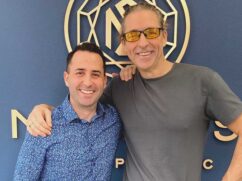
“Dr. Mike improved the mobility of my spine measurably. The whole team is incredibly flexible and helpful to work with. Everything is fast and easy.”

Author, biohacker, and founder of Bulletproof Nutrition

“Dr. Mike and the team at Mōtus are top notch. The adjustments are specific and the analysis is beyond thorough. If you’re in Austin, this is the spot for high-level Chiropractic care.”
– Adrian Grenier
Actor and Film Producer

ABOUT DR. MIKE ISSEKS
Dr. Mike has been a practicing chiropractor for more than 15 years. He is a graduate of California State University at Chico and received his Doctor of Chiropractic degree from Life Chiropractic College West. He specializes in corrective care chiropractic, improving posture, as well as optimizing spinal motion to help uncover the best version of those he serves.
STAY IN THE KNOW
Get cutting-edge health tips, updates, and event notifications...
By entering your email above and clicking “Sign-Up,” you agree to receive occasional emails from Mōtus Chiropractic.
VISIT US
Trio at Menchaca Business Park
Ample free parking in the front lot
HOURS
Monday, Tuesday, Thursday
8:30 am – 12 pm
2:30 pm – 6 pm
Wednesday
12 pm – 5 pm
REACH US
(512) 777-2680
hello@motusatx.com
STAY IN THE KNOW
Get cutting-edge health tips, updates, and event notifications...
By entering your email above and clicking “Sign-Up,” you agree to receive occasional emails from Mōtus Chiropractic.
Copyright 2022, Mōtus Chiropractic. All rights reserved.