
THE MŌTUS BLOG
July 19, 2026
Spinal Adjustment vs Physical Therapy for Pain
A stiff neck after long hours at your desk. Low back pain that changes how you train. Headaches that keep returning despite massage, stretching, and another round of pain relievers. When your body stops moving the way it should, the question is not simply how to feel better this week. It is how to restore the function that lets you work, train, travel, and live at full capacity.
That is where the spinal adjustment vs physical therapy conversation begins. Both can play a valuable role in recovery, but they are not interchangeable. One may be more appropriate based on the source of your limitation, your current movement capacity, and whether your care plan is designed for short-term relief or durable correction.
Spinal Adjustment vs Physical Therapy: The Core Difference
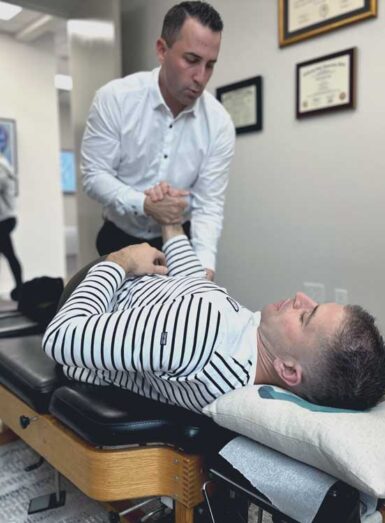
A spinal adjustment is a precise, controlled force applied to a specific spinal joint to improve joint motion and reduce restrictions. In chiropractic care, the goal is not to chase symptoms from one sore area to the next. It is to identify where spinal motion, alignment, and nervous-system communication may be compromised, then address those patterns with an individualized corrective plan.
Physical therapy typically centers on rehabilitation through guided exercise, manual therapy, movement retraining, and progressive loading. A physical therapist may help restore strength, stability, balance, mobility, and confidence after an injury, surgery, or period of reduced activity.
Both approaches can involve hands-on care and both may include mobility work. The distinction is in their primary focus. Chiropractic adjustment focuses directly on spinal and joint dysfunction. Physical therapy focuses heavily on rebuilding the muscular control and movement tolerance required for daily life, sport, or post-injury recovery.
For many active adults, the real answer is not an either-or decision. A restricted spinal segment can make it harder to move well. Poor movement control can reinforce stress on the spine. Addressing only one side of that equation may leave progress on the table.
When a Spinal Adjustment May Be the Better Starting Point
An adjustment may make sense when a thorough examination points to joint restriction, altered spinal motion, postural distortion, or movement compensation that is limiting how your body functions. People often seek chiropractic care for neck pain, back pain, recurring headaches, reduced range of motion, and stiffness that never fully resolves.
The right adjustment is not a generic crack-and-go experience. A corrective approach begins with understanding the pattern. That can include a detailed health history, posture assessment, orthopedic and neurological testing, range-of-motion evaluation, and, when clinically appropriate, pre- and post-motion X-ray studies. The objective is to see what your body is doing, not guess from where it hurts.
For example, pain between the shoulder blades may not begin between the shoulder blades. It can be influenced by a forward-head posture, restricted movement in the neck or upper back, an old injury, repetitive desk positioning, or a training pattern that your body has learned to compensate around. An adjustment may help restore motion in the restricted area, but lasting change requires a plan that addresses why the restriction developed and why it keeps returning.
That is the difference between temporary relief and corrective care. If your back feels better for a few days but repeatedly tightens after a workout, commute, or workweek, stop settling for care that only quiets the alarm. Your body is asking for a deeper assessment.
When Physical Therapy May Be the Better Fit
Physical therapy can be especially valuable after surgery, a significant injury, immobilization, or a clear loss of strength and stability. If you are recovering from an ACL reconstruction, rotator cuff repair, fracture, or major tendon injury, progressive rehabilitation is often central to returning safely to activity.
It can also be the right choice when pain has caused you to avoid movement for months. In those cases, your body may need a structured path back to loading, coordination, and confidence. A strong physical therapy program does more than hand you a resistance band. It assesses how you move, identifies what you can tolerate today, and builds capacity over time.
The trade-off is that exercise alone may not fully address a specific spinal joint restriction or structural pattern contributing to the problem. You can strengthen around dysfunction for a while, but if the underlying mechanics remain unchanged, certain exercises may feel frustratingly limited or keep provoking the same area.
Physical therapy is most powerful when it is specific. The exercises should match your actual movement deficits, goals, sport demands, and recovery stage. A generic sheet of stretches is not the same thing as a rehabilitation plan.
Why Combining Care Can Be a Strategic Move
For an athlete, entrepreneur, parent, or professional who expects a lot from their body, combining chiropractic and rehabilitative exercise can be a smart strategy. Adjustments can help restore joint motion and reduce the mechanical barriers that make movement feel guarded or restricted. Targeted exercises can then reinforce better mechanics, build strength, and help your body own that improved range of motion.
Think of it this way: restoring motion matters, but retaining it matters just as much. If your hips, thoracic spine, or neck begin moving better after care but you return to the same posture, training imbalance, or sedentary work pattern without support, the old compensation can reassert itself.
A thoughtful plan may include adjustments, posture correction, mobility work, stability training, ergonomic changes, recovery habits, and progressive strengthening. The exact combination depends on the person in front of the provider. There is no serious one-size-fits-all solution for a body with your injury history, workload, training schedule, and goals.
At Mōtus Chiropractic, that principle is central: measure the dysfunction, educate the patient, create a personalized correction strategy, and reassess progress. High-level care should give you a clear answer to an essential question: Is your body actually changing, or are you simply receiving repeated symptom management?
How to Choose the Right Care for Your Situation
Start by looking beyond the location of your pain. Pain is information, but it is not always the source of the problem. A sharp pain after an acute injury needs a different response than years of recurring neck tension. A post-surgical knee has different requirements than a healthy knee that is overloaded because of poor hip control and restricted spinal movement.
A spinal adjustment may be worth prioritizing if you notice recurring stiffness, restricted turning or bending, posture changes, headaches associated with neck tension, or pain that improves temporarily but returns with predictable patterns. Physical therapy may deserve priority if you are recovering from surgery, need a progressive return-to-sport protocol, have significant weakness after injury, or require carefully monitored loading.
There are also times to seek medical evaluation before either route. New or worsening weakness, numbness, loss of coordination, bowel or bladder changes, fever, unexplained weight loss, severe trauma, or pain that is constant and unrelenting should not be treated as a routine muscle problem. The right provider knows when to treat, when to co-manage, and when to refer.
Questions That Reveal Whether Care Is Built for Results
Before committing to any care plan, ask how the provider determines the root cause of your problem. Ask what objective measures they use, how they track change, and what success will look like beyond a lower pain score. You should also understand the expected timeline, the role you need to play between visits, and how your plan will evolve as you improve.
Be cautious of two extremes: the promise that one appointment will permanently fix everything, and the vague recommendation to keep coming indefinitely without a measurable reason. Healing can take time, particularly when a problem has developed over years. But a quality plan should still have direction, benchmarks, and a rationale.
Your care should respect your ambition. Whether you want to dead lift without hesitation, finish a demanding workday without a headache, keep up with your kids, or move through Austin without planning your day around pain, your body deserves more than a temporary patch. Choose the approach that identifies what is limiting you, restores the movement you have lost, and gives you a real path to keep it. Learn more at Mōtus' state-of-the-art facility in South Austin!
Mōtus Chiropractic is a top-rated chiropractor located in Austin, TX. Dr. Mike Isseks offers more than 15 years experience helping his patients alleviate pain and Move Consciously. To schedule a visit, click here.
RECLAIM YOUR LIFE
Rebuild your body and reduce your pain with our progressive technology, proven alternative methods of care, and integrative chiropractic experience.
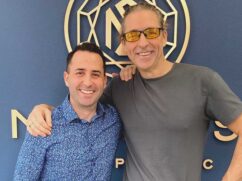
“Dr. Mike improved the mobility of my spine measurably. The whole team is incredibly flexible and helpful to work with. Everything is fast and easy.”

Author, biohacker, and founder of Bulletproof Nutrition

“Dr. Mike and the team at Mōtus are top notch. The adjustments are specific and the analysis is beyond thorough. If you’re in Austin, this is the spot for high-level Chiropractic care.”
– Adrian Grenier
Actor and Film Producer

ABOUT DR. MIKE ISSEKS
Dr. Mike has been a practicing chiropractor for more than 15 years. He is a graduate of California State University at Chico and received his Doctor of Chiropractic degree from Life Chiropractic College West. He specializes in corrective care chiropractic, improving posture, as well as optimizing spinal motion to help uncover the best version of those he serves.
STAY IN THE KNOW
Get cutting-edge health tips, updates, and event notifications...
By entering your email above and clicking “Sign-Up,” you agree to receive occasional emails from Mōtus Chiropractic.

VISIT US
Trio at Menchaca Business Park
Ample free parking in the front lot
HOURS
Monday, Tuesday, Thursday
8:30 am – 12 pm
2:30 pm – 6 pm
Wednesday
12 pm – 5 pm
REACH US
(512) 777-2680
hello@motusatx.com
STAY IN THE KNOW
Get cutting-edge health tips, updates, and event notifications...
By entering your email above and clicking “Sign-Up,” you agree to receive occasional emails from Mōtus Chiropractic.
Copyright 2022, Mōtus Chiropractic. All rights reserved.