
THE MŌTUS BLOG
August 13, 2026
A Guide to Mobility Restoration Care That Lasts
Your body should not feel like the limiting factor in your ambition. If tight hips change the way you run, neck tension steals your focus, or recurring back pain dictates how you train, the problem is bigger than one uncomfortable day. This guide to movement restoration care is for people who are done managing symptoms and ready to understand why their body stopped moving the way it should.
Movement restoration is not about chasing a temporary feeling of relief. It is about restoring the structural alignment, joint motion, muscular coordination, and nervous-system communication that allow your body to perform under real life demands. For active adults, that means more capacity for work, training, travel, parenting, and the moments that should not require a recovery plan.
What Mobility Restoration Care Looks Like
Movement restoration care is a root-cause approach to restricted, painful, or inefficient movement. Rather than asking only, "Where does it hurt?" a skilled provider asks, "What changed in the way your body moves, and what is driving that change?"
Pain is useful information, but it is rarely the full diagnosis. A shoulder may hurt because of poor shoulder mechanics, but those mechanics can be influenced by a stiff upper back, forward-head posture, an old injury, altered spinal alignment, or a nervous system that has adapted to chronic stress and protective tension. Treating the shoulder alone may provide relief. Identifying the entire pattern creates a path toward lasting change.
This is why movement restoration often brings together corrective chiropractic care, posture analysis, range-of-motion testing, targeted mobility work, stabilization, and practical habits outside the office. The exact mix depends on the individual. There is no serious corrective-care model built around a generic adjustment and a vague instruction to "stretch more."
A Guide to Movement Restoration Care Starts With Proof
If your care plan cannot explain what is restricted, misaligned, or underperforming, it is hard to know whether you are truly improving. Subjective feedback matters, but it should not be the only measure. Feeling better after a session is encouraging. Demonstrating improved spinal motion, posture, functional range, or imaging findings over time is more meaningful.
A thorough evaluation begins with your story. When did symptoms begin? What activities trigger them? What past injuries, training demands, work habits, sleep positions, or stressors may be contributing? Your provider should listen for patterns, not rush you toward a standard protocol.
From there, objective testing can reveal what a quick exam misses. Functional range-of-motion assessment may show where motion is limited or where the body is compensating. Postural analysis can identify patterns such as forward head carriage, uneven shoulder height, pelvic imbalance, or spinal curves that change load distribution. When clinically appropriate, pre- and post-motion X-ray studies can help evaluate spinal alignment and segmental movement with greater precision.
That detail matters because a body can look functional while quietly borrowing movement from the wrong places. A mobile low back may be compensating for stiff hips. A constantly tight neck may be doing the work of an underperforming upper back. The goal is not to label every asymmetry as a problem. It is to identify the patterns that are costing you function, energy, and resilience.
Stop Chasing Flare-Ups and Correct the Pattern
Short-term symptom relief has a place. Acute pain can be disruptive, and reducing irritation matters. But relief without correction often leads to a frustrating cycle: feel better, return to normal activity, flare up, repeat. You deserve more than a temporary reset.
Corrective care focuses on the pattern beneath the flare-up. In chiropractic practice, this may include addressing spinal subluxations and joint restrictions that interfere with normal movement and nervous-system communication. Specific adjustments can help restore motion where joints are restricted, while complementary corrective strategies help the body hold and use that improved motion.
The trade-off is that meaningful change requires more than a single visit. Longstanding posture and movement patterns developed over months or years. They may involve tissue adaptation, habitual loading, motor control, and repeated environmental stress. A thoughtful plan should be phased, with enough consistency early on to create change and regular reassessment to determine whether the plan is working.
That does not mean every issue requires the same timeline. A recent mobility restriction after a minor strain may respond quickly. A chronic pattern involving spinal degeneration, a significant old injury, or years of desk-based posture usually needs a longer corrective strategy. The honest answer is: it depends on what the assessment reveals and how consistently you participate.
What a Customized Corrective Plan Can Include
A high-quality plan connects the findings of your assessment to your actual life. A runner needs a different return-to-performance strategy than a software founder who spends ten hours a day at a desk. A parent lifting a toddler has different demands than a competitive lifter rebuilding after a shoulder issue. The care should be specific enough to matter when you leave the office.
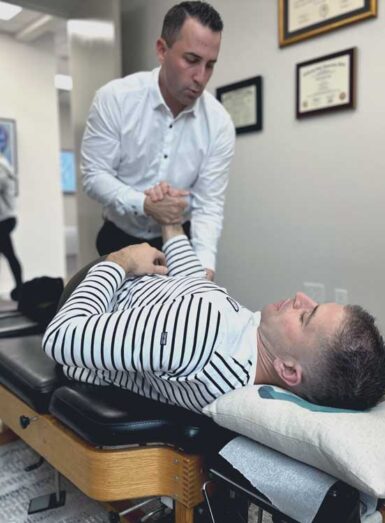
In-office care may include precise chiropractic adjustments intended to improve spinal and joint motion, along with corrective recommendations designed around posture, mobility, stability, and movement control. The objective is not to create dependence on care. It is to help your body regain the capacity to move well without constantly compensating.
Outside the office, the most effective recommendations are usually simple enough to repeat. That might mean changing a workstation setup, taking intentional movement breaks, modifying a training pattern temporarily, using a specific mobility drill, or practicing stabilization work that reinforces a new movement pattern. More exercises are not necessarily better. The right exercise, performed consistently and at the right stage of care, is what counts.
At Mōtus Chiropractic, this process is built around measurable diagnostics and individualized corrective plans rather than a one-size-fits-all approach. You should understand what is being addressed, why it matters, what progress looks like, and when your plan will be reevaluated.
Your Daily Choices Determine How Well Care Holds
A corrective adjustment can create an opportunity for better movement. Your daily behavior helps determine whether that opportunity becomes a new baseline. If you return immediately to the same workstation position, training errors, sleep setup, or stress-driven tension pattern, the body has a strong reason to return to what it knows.
This is not about perfection. It is about self-responsibility. Build a few supportive practices into the day: change positions before discomfort becomes intense, prioritize recovery after demanding training, maintain strength through useful ranges of motion, and pay attention to the activities that consistently provoke compensation.
For many high performers, the hardest adjustment is accepting that more intensity is not always the answer. You cannot out-train a movement pattern that is breaking down. Sometimes the fastest route back to performance is a temporary reduction in load while you restore control, alignment, and capacity. That is not retreating. It is training with intelligence.
Know When Movement Care Needs a Broader Medical Team
Movement restoration care is valuable, but responsible care also recognizes its boundaries. New severe pain after trauma, unexplained weakness, numbness that is progressing, changes in bowel or bladder control, fever, unexplained weight loss, chest pain, or significant balance changes require prompt medical evaluation. Do not try to stretch, adjust, or train through red flags.
Some conditions also benefit from coordinated care with primary care physicians, orthopedic specialists, neurologists, physical therapists, or other qualified professionals. The best provider is not the one who claims to handle everything. It is the one who can identify what your body needs and direct you to the right level of support.
Your body is adaptable, even when it has spent years operating around pain or restriction. Stop settling for a strategy built only around getting through the next flare-up. Start paying attention to the signals, demand objective answers, and give your body the consistent corrective input it needs to carry your life with more strength, freedom, and confidence.
Mōtus Chiropractic is a top-rated chiropractor located in Austin, TX. Dr. Mike Isseks offers more than 15 years experience helping his patients alleviate pain and Move Consciously. To schedule a visit, click here.
RECLAIM YOUR LIFE
Rebuild your body and reduce your pain with our progressive technology, proven alternative methods of care, and integrative chiropractic experience.
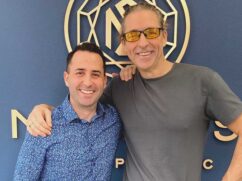
“Dr. Mike improved the mobility of my spine measurably. The whole team is incredibly flexible and helpful to work with. Everything is fast and easy.”

Author, biohacker, and founder of Bulletproof Nutrition

“Dr. Mike and the team at Mōtus are top notch. The adjustments are specific and the analysis is beyond thorough. If you’re in Austin, this is the spot for high-level Chiropractic care.”
– Adrian Grenier
Actor and Film Producer

ABOUT DR. MIKE ISSEKS
Dr. Mike has been a practicing chiropractor for more than 15 years. He is a graduate of California State University at Chico and received his Doctor of Chiropractic degree from Life Chiropractic College West. He specializes in corrective care chiropractic, improving posture, as well as optimizing spinal motion to help uncover the best version of those he serves.
STAY IN THE KNOW
Get cutting-edge health tips, updates, and event notifications...
By entering your email above and clicking “Sign-Up,” you agree to receive occasional emails from Mōtus Chiropractic.

VISIT US
Trio at Menchaca Business Park
Ample free parking in the front lot
HOURS
Monday, Tuesday, Thursday
8:30 am – 12 pm
2:30 pm – 6 pm
Wednesday
12 pm – 5 pm
REACH US
(512) 777-2680
hello@motusatx.com
STAY IN THE KNOW
Get cutting-edge health tips, updates, and event notifications...
By entering your email above and clicking “Sign-Up,” you agree to receive occasional emails from Mōtus Chiropractic.
Copyright 2022, Mōtus Chiropractic. All rights reserved.