
THE MŌTUS BLOG
July 28, 2026
Restoring Spinal Motion and Alignment: What to Expect
If your neck keeps tightening by 3 p.m., your low back talks back after workouts, or headaches show up like clockwork, the problem may not be a lack of stretching or another temporary fix. A chiropractor who specializes in restoring spinal motion and alignment looks at the structure and motion of your spine to find what is actually driving the tension, pain, and performance drop-off. That distinction matters when you are done settling for short-term relief.
Most people do not seek care because one thing hurts once. They come in because their body has started negotiating with them. You skip the lift that used to feel easy. You sit differently at your desk because one side always feels off. You wake up stiff, train around the problem, push through the workday, and tell yourself you will deal with it later. Later usually becomes a pattern.
A misaligned spine is not just a comfort issue. It can affect posture, movement quality, joint stress, muscle tension, and how efficiently your nervous system communicates with the rest of your body. When those faults stay in place long enough, compensation becomes your normal. That is why symptom-based care often falls short. If no one measures what is moving poorly, what is compressed, or what is repeatedly overloaded, you are left managing effects instead of correcting causes.
What a chiropractor actually does
A chiropractor is not simply cracking joints and sending you on your way. At a high level, the job is to identify structural distortions, movement restrictions, and spinal stress patterns that interfere with healthy function, then build a plan to correct them over time.
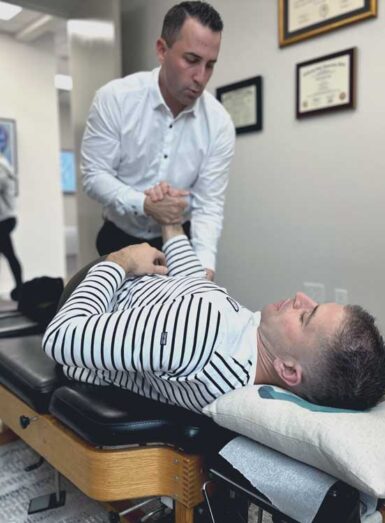
That starts with a more serious evaluation than many people expect. If care is going to be corrective instead of generic, the doctor needs objective information. That can include posture analysis, spinal range-of-motion testing, neurological and orthopedic exams, and imaging when clinically appropriate. In a corrective model, pre- and post-care comparisons matter because progress should be visible, not guessed.
The adjustment itself is only one part of the process. A precise chiropractic adjustment can reduce joint restriction, restore segmental motion, and decrease abnormal stress on surrounding tissues. But long-term alignment usually also requires changes in posture, movement habits, stability, recovery, and how consistently care is delivered. If the spine has been adapting to bad mechanics for years, one visit is rarely the whole answer.
Why alignment matters beyond pain relief
Pain gets attention because it is loud. Alignment problems often build quietly first.
A forward head posture can increase strain through the neck and upper back. A restricted mid-back can force the neck and shoulders to work harder. A rotated pelvis or lumbar imbalance can shift load into one hip, one knee, or one side of the low back. Over time, that can show up as headaches, tight traps, sciatica-like symptoms, reduced rotation, shallow breathing, or the sense that your body just does not move cleanly anymore.
For active adults, alignment affects output. You cannot perform at a high level on top of poor mechanics forever. Maybe you still get through your workouts, but your recovery lags. Maybe your golf swing feels limited on one side. Maybe your runs leave you more beat up than they should. When the spine is not moving or stacking well, efficiency drops and compensation rises.
This is also where the nervous system conversation matters. Your spine houses and protects the spinal cord, and joint dysfunction can change the way the body perceives and coordinates movement. The goal of corrective chiropractic care is not just to make you feel looser for a day. It is to improve the quality of the signal, the quality of the motion, and the quality of the stress your body experiences every day.
Signs you may need this type of structural corrective approach
Not everyone with poor alignment has dramatic pain. In fact, some of the clearest signs are subtle at first.
You may notice recurring neck or back tension, headaches, numbness or tingling, reduced mobility, uneven posture in photos, one shoulder sitting higher than the other, or constant stiffness after sleeping or sitting. Some people feel unstable during exercise or discover they are stronger and more mobile on one side. Others simply feel worn down by a body that no longer feels responsive.
The bigger clue is repetition. If the same issue keeps returning despite massage, stretching, rest, or random adjustments, there is usually a reason. Recurrent symptoms are often a message that the underlying structure and movement pattern have not been corrected.
What separates corrective care from quick relief
This is where many patients make the wrong comparison. They think all chiropractic care is basically the same, and it is not.
Relief care focuses on reducing symptoms as quickly as possible. That can be useful, especially during an acute flare-up. But if your spine has been under abnormal stress for months or years, relief alone is rarely durable. The body tends to return to the same faulty pattern.
Corrective care takes a longer view. It asks better questions. What caused the pressure in the first place? Where is motion restricted? Which postural collapse is feeding the problem? How do we verify improvement instead of assuming it? That approach requires more precision, more education, and usually more commitment from the patient. The trade-off is that it aims for lasting change, not repeated dependence on temporary relief.
For the right patient, that is worth it. If you are motivated, active, and serious about your health, generic care will eventually feel like a dead end. You do not need another patch. You need a plan.
What to expect during care
A high-level spinal correction program should feel personalized from day one. Your history matters. Your work posture matters. Your training matters. Your injury patterns, sleep habits, and stress load matter. If care ignores those variables, it is not really customized.
After the initial evaluation, the chiropractor should explain what they found in plain English. You should understand where your alignment is breaking down, how that affects your symptoms and performance, and what the proposed timeline looks like. There is no magic in this. The body changes through accurate care and repetition.
Treatment may include specific spinal adjustments, posture retraining, mobility work, stabilization strategies, and recommendations for how to sit, move, train, or recover more intelligently. In a practice built around measurable outcomes, re-exams are a major part of the process. They show whether your spine is actually changing and whether the plan needs refinement.
That last part matters because healing is not perfectly linear. Some patients respond quickly. Others need more time because the problem is older, more degenerative, or tied to lifestyle patterns that are still working against them. A trustworthy chiropractor will be direct about that. Fast is great when possible. Lasting is better.
Is chiropractic spinal alignment right for everyone?
No, and that honesty matters.
If you want one visit to erase years of stress, poor posture, and movement dysfunction, your expectations need to change. If your condition requires co-management, imaging, or referral, that should be addressed clearly. And if you are not willing to follow through with a care plan, home guidance, or postural changes, results can be limited.
But for people who want a natural, structured, and evidence-informed path forward, chiropractic care can be a powerful fit. It is especially valuable for those who feel stuck between extremes - not injured enough for surgery, but too limited to keep living and training the way they want. That middle ground is where a lot of high-functioning adults lose years.
The right chiropractor does not treat you like a symptom list. They assess your body as an integrated system and show you what needs to change. At Mōtus Chiropractic, that means combining advanced motion testing, imaging when needed, and individualized corrective strategies to help patients restore alignment, reclaim movement, and stop guessing about their health.
Choosing the right spinal alignment chiropractor
Do not choose based on convenience alone. Choose based on method.
Look for a doctor who performs a thorough exam, uses objective findings, explains care clearly, and builds a plan around correction rather than endless maintenance with no measurable target. Ask how progress is tracked. Ask what happens if you plateau. Ask how posture, mobility, and daily habits are addressed between visits.
You should also pay attention to philosophy. Some providers are built for quick throughput. Others are built for transformation. If your goal is to get back to high-level work, training, parenting, travel, and life with a body that feels strong and dependable, you want the second type.
Stop settling for care that only chases pain after it appears. Your spine influences how you move, recover, and show up in every part of your life. When alignment improves, people often notice more than less pain - they feel more capable, more stable, and more like themselves again. That is the real standard worth aiming for.
Mōtus Chiropractic is a top-rated chiropractor located in Austin, TX. Dr. Mike Isseks offers more than 15 years experience helping his patients alleviate pain and Move Consciously. To schedule a visit, click here.
RECLAIM YOUR LIFE
Rebuild your body and reduce your pain with our progressive technology, proven alternative methods of care, and integrative chiropractic experience.
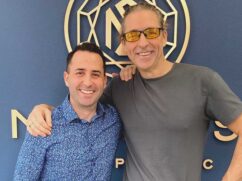
“Dr. Mike improved the mobility of my spine measurably. The whole team is incredibly flexible and helpful to work with. Everything is fast and easy.”

Author, biohacker, and founder of Bulletproof Nutrition

“Dr. Mike and the team at Mōtus are top notch. The adjustments are specific and the analysis is beyond thorough. If you’re in Austin, this is the spot for high-level Chiropractic care.”
– Adrian Grenier
Actor and Film Producer

ABOUT DR. MIKE ISSEKS
Dr. Mike has been a practicing chiropractor for more than 15 years. He is a graduate of California State University at Chico and received his Doctor of Chiropractic degree from Life Chiropractic College West. He specializes in corrective care chiropractic, improving posture, as well as optimizing spinal motion to help uncover the best version of those he serves.
STAY IN THE KNOW
Get cutting-edge health tips, updates, and event notifications...
By entering your email above and clicking “Sign-Up,” you agree to receive occasional emails from Mōtus Chiropractic.

VISIT US
Trio at Menchaca Business Park
Ample free parking in the front lot
HOURS
Monday, Tuesday, Thursday
8:30 am – 12 pm
2:30 pm – 6 pm
Wednesday
12 pm – 5 pm
REACH US
(512) 777-2680
hello@motusatx.com
STAY IN THE KNOW
Get cutting-edge health tips, updates, and event notifications...
By entering your email above and clicking “Sign-Up,” you agree to receive occasional emails from Mōtus Chiropractic.
Copyright 2022, Mōtus Chiropractic. All rights reserved.